
 eaton-bussmann-series-dc-fuses-catalog-ca135009en-us.pdf  | [Eaton Bussmann DC Fuses] | 0 kB |
| eaton-bussmann-series-high-speed-fuses-application-guide-br132015en-en-us.pdf | [Eaton Bussmann Fuses Technical Guide] | 0 kB |
HRC Fuse vs DC Fuse: Which One Should You Choose for Your Application?
Choosing the right fuse is essential for protecting electrical systems against overloads, short circuits, and equipment damage. However, when comparing an HRC fuse vs a DC fuse, many engineers and electrical professionals find it difficult to determine which option is best for their applications.
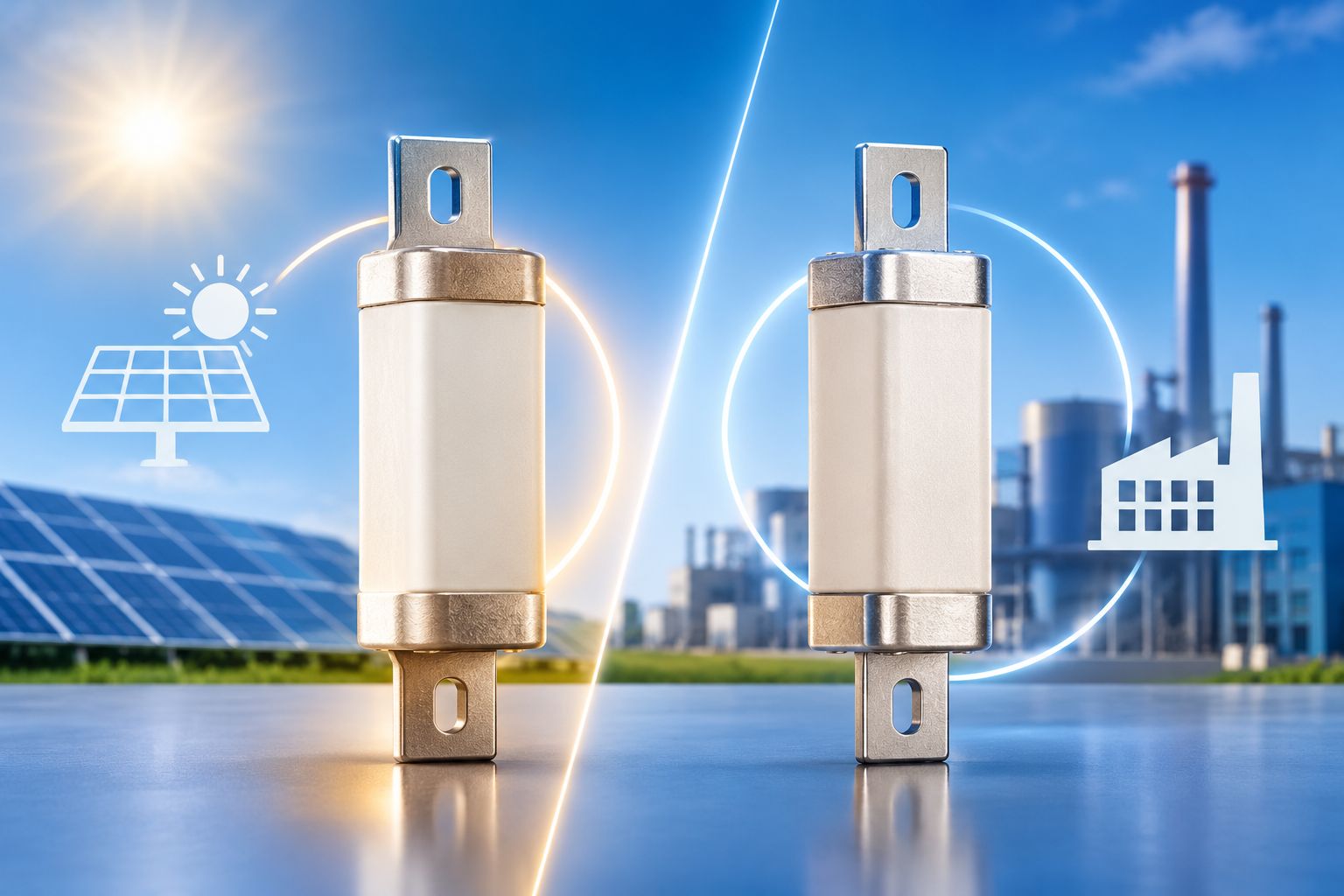
Although both types of fuses provide overcurrent protection, they are designed to address different electrical challenges. HRC fuses are primarily recognised for their high rupturing capacity and ability to interrupt substantial fault currents. DC fuses, on the other hand, are specifically designed to safely interrupt direct current circuits, where extinguishing an electrical arc can be more challenging.
Understanding their differences in construction, operating principles, voltage ratings, breaking capacity, and applications can help you make an informed decision.
In this guide, we will explore the key differences between HRC fuses and DC fuses, their advantages, common applications, and the important factors to consider when selecting the right fuse for your electrical system.
What Is an HRC Fuse?
HRC stands for High Rupturing Capacity. An HRC fuse is an electrical protection device designed to interrupt high fault currents safely without causing damage to the surrounding electrical equipment.
These fuses are commonly used in industrial power distribution systems, electrical panels, switchgear, motor circuits, and commercial installations where high short-circuit currents may occur.
How Does an HRC Fuse Work?
An HRC fuse typically consists of a ceramic or heat-resistant insulating body, a metal fuse element, and an arc-quenching filling material, commonly silica sand.
Under normal operating conditions, electrical current flows through the fuse element without interruption.
When an overload or short circuit occurs, the current increases beyond the fuse's rated capacity. This excessive current generates heat, causing the fuse element to melt and break the circuit.
The silica sand inside the fuse body absorbs the heat generated during the interruption process and helps extinguish the electrical arc. This prevents the arc from continuing and reduces the risk of equipment damage.
Key Features of HRC Fuses
-
High breaking capacity: Designed to interrupt high levels of short-circuit current.
-
Reliable protection: Helps protect electrical equipment against overloads and short circuits.
-
Arc-quenching capability: Uses specialised filling materials to control and extinguish electrical arcs.
-
Robust construction: Typically features a strong insulating body designed to withstand high temperatures and electrical stresses.
-
Industrial applications: Widely used in distribution boards, switchgear, motor protection, and industrial electrical systems.
HRC fuses are available in different configurations, including cartridge-type, cylindrical, and blade-type designs.
What Is a DC Fuse?
A DC fuse is an electrical protection device specifically designed and rated to operate in direct current (DC) circuits.
Unlike alternating current (AC), direct current flows continuously in one direction. This creates a particular challenge during fault interruption because DC circuits do not have the natural current zero-crossing that helps extinguish electrical arcs in AC systems.
When a fuse element melts in a DC circuit, an electrical arc can form between the separated ends of the element. If this arc is not extinguished effectively, it may continue conducting current and create a serious safety hazard.
DC fuses are engineered to overcome this challenge through specialised internal construction and arc-quenching designs.
How Does a DC Fuse Work?
When excessive current flows through a DC fuse, its internal fuse element heats up and melts.
The fuse then creates an interruption gap. Specialised arc-quenching materials and internal design features help absorb the energy of the arc, cool the ionised gases, and extinguish the electrical discharge.
Depending on the fuse design, these features may include:
-
Extended arc paths.
-
Specialised arc-quenching fillers.
-
Optimised fuse element geometry.
-
Suitable insulating materials.
-
Enhanced voltage withstand capabilities.
These design characteristics allow DC fuses to interrupt direct current safely at their specified operating voltage and breaking capacity.
Key Features of DC Fuses
-
DC-rated operation: Specifically designed and tested for direct current applications.
-
Arc suppression: Helps extinguish sustained DC electrical arcs.
-
High-voltage protection: Available for various DC voltage levels, depending on the application.
-
Reliable fault interruption: Protects sensitive electrical components and power distribution equipment.
-
Application-specific designs: Available for solar photovoltaic systems, battery energy storage, electric vehicles, and DC power systems.
HRC Fuse vs DC Fuse: Key Differences
The primary difference between an HRC fuse and a DC fuse lies in their defining characteristics.
HRC describes a fuse's high rupturing capacity, whereas DC describes its suitability for direct current applications. These classifications are not mutually exclusive. An HRC fuse can also be suitable for DC applications if it has the appropriate DC voltage and breaking capacity ratings.
The following comparison highlights their main differences.
| Comparison Factor | HRC Fuse | DC Fuse |
|---|---|---|
| Main purpose | Interrupting high fault currents | Protecting DC electrical circuits |
| Operating principle | Melts the fuse element during excessive current | Melts the fuse element and extinguishes the DC arc |
| Current type | Commonly used in AC systems; some models are DC-rated | Specifically rated for DC applications |
| Breaking capacity | Designed for high fault current interruption | Depends on the specific DC fuse design |
| Arc interruption | Uses internal arc-quenching materials | Uses specialised DC arc-extinguishing designs |
| Voltage rating | Separate AC and DC ratings may apply | Designed with a specified DC voltage rating |
| Common applications | Industrial distribution, switchgear, and motor circuits | Solar PV, battery storage, EV systems, and DC drives |
| Construction | Typically ceramic body with metal fuse elements and filler | Often ceramic body with specialised fuse elements and arc-quenching filler |
An important point to remember is that an HRC fuse may also carry a DC rating. Therefore, the correct selection should always be based on the manufacturer's specifications rather than the fuse category alone.
Why Is DC Fuse Protection Different from AC Fuse Protection?
One of the most important considerations when selecting electrical protection is understanding the difference between AC and DC fault interruption.
In an AC electrical system, current periodically changes direction and naturally passes through zero. At these zero-crossing points, the electrical arc generated when a fuse element melts has an opportunity to extinguish.
In a DC electrical system, current flows continuously in one direction. There is no natural current zero-crossing to assist arc interruption.
As a result, a DC electrical arc can remain active after the fuse element melts unless the fuse is specifically designed to extinguish it.
This is why DC fuse designs often require specialised arc-quenching characteristics and suitable internal construction.
Why Are DC Voltage Ratings Important?
A fuse's AC voltage rating cannot automatically be considered its DC voltage rating.
For example, a fuse rated at 690V AC may have a substantially lower DC voltage rating, depending on its construction and testing.
Using an AC-only fuse in a DC circuit without an adequate DC rating can result in an electrical arc that the fuse cannot safely interrupt.
For this reason, always verify the DC voltage rating, breaking capacity, and application suitability before installing a fuse in a direct current system.
When Should You Choose an HRC Fuse?
An HRC fuse is generally a suitable choice when your primary requirement is reliable protection against high fault currents in industrial or commercial electrical distribution systems.
Common applications include:
1. Industrial Power Distribution
Industrial electrical distribution systems often experience high prospective short-circuit currents.
HRC fuses provide effective short-circuit protection for distribution boards, busbars, feeders, and electrical switchgear.
2. Motor Protection
Electric motors can experience high starting currents and potentially damaging short-circuit conditions.
HRC fuse links are commonly used alongside suitable overload protection devices to provide short-circuit protection for motor circuits.
3. Commercial Electrical Installations
Commercial buildings, electrical control panels, and power distribution assemblies require reliable protection against electrical faults.
HRC fuses can provide high breaking capacity in applications where their voltage and current ratings are suitable.
4. Low-Voltage DC Applications
Some HRC fuses are also suitable for DC applications, provided their DC voltage and breaking capacity ratings meet the requirements of the circuit.
They may be considered for certain battery systems and industrial DC applications operating at relatively moderate voltages.
However, suitability must always be confirmed using the manufacturer's datasheet.
When Should You Choose a DC Fuse?
A dedicated DC fuse is generally the preferred choice when protecting direct current systems, particularly those operating at higher voltages or involving significant stored electrical energy.
Some of the most common applications include:
1. Solar Photovoltaic Systems
Solar PV installations generate direct current, making appropriate DC-rated protection essential.
DC fuses are used in photovoltaic string circuits, combiner boxes, and other parts of solar power systems to protect against overcurrent conditions.
For photovoltaic applications, gPV fuses are specifically designed for solar circuit protection and are covered by IEC 60269-6.
2. Battery Energy Storage Systems
Battery energy storage systems can deliver substantial fault currents because of the energy stored within their battery cells and modules.
DC fuses help protect battery racks, battery modules, DC busbars, and power conversion equipment.
Selecting the correct fuse requires careful consideration of the system voltage, prospective fault current, and the equipment's short-circuit withstand capability.
3. Electric Vehicle Charging Systems
Electric vehicle charging infrastructure contains high-power DC electrical circuits that require reliable fault protection.
DC fuses are used in suitable charging equipment, power conversion circuits, and battery-related applications to interrupt fault currents safely.
4. DC Drives and Power Conversion Equipment
Industrial DC drives, rectifiers, and power converters contain sensitive electrical components that may be damaged by excessive current.
Appropriately selected DC fuses help protect these components against short-circuit conditions and other electrical faults.
How to Choose Between an HRC Fuse and a DC Fuse
Selecting the correct fuse requires more than comparing product names or current ratings. You must evaluate the electrical characteristics of the application and ensure that the selected fuse can safely interrupt the maximum possible fault current.
Here are six important factors to consider.
1. Identify Whether the Circuit Is AC or DC
Start by identifying the type of electrical supply.
For AC circuits, an appropriately rated HRC fuse may be suitable.
For DC circuits, select a fuse with a verified DC voltage rating that meets or exceeds the maximum system voltage.
Never assume that an AC-rated fuse is suitable for DC operation.
2. Check the Operating Voltage
The fuse voltage rating must be compatible with the maximum voltage that can occur across the circuit under the relevant operating conditions.
For DC applications, check the actual DC voltage rating rather than relying on the AC rating.
Consider maximum system voltage, operating conditions, and any relevant transient or overvoltage requirements.
3. Determine the Required Current Rating
The rated current of the fuse must be appropriate for the normal operating current of the protected circuit.
An undersized fuse may operate unnecessarily, while an oversized fuse may fail to provide adequate protection.
Consider the following factors:
-
Normal operating current.
-
Load characteristics.
-
Ambient temperature.
-
Enclosure temperature.
-
Continuous operating conditions.
-
Manufacturer-recommended derating factors.
4. Verify the Breaking Capacity
Breaking capacity, also known as interrupting capacity, refers to the maximum prospective fault current that a fuse can safely interrupt under its specified conditions.
The selected fuse must have a breaking capacity equal to or greater than the available prospective short-circuit current at its installation point.
This is particularly important in battery energy storage systems and industrial electrical installations, where fault currents can be extremely high.
5. Consider Energy Coordination and I²t Ratings
The I²t rating represents the thermal energy associated with current flow during fuse operation.
When protecting sensitive electronic equipment, such as inverters, semiconductor devices, and power conversion systems, the fuse's total clearing I²t must be coordinated with the withstand capability of the protected components.
Proper coordination helps minimise thermal and electrical damage during fault conditions.
6. Check Standards and Installation Compatibility
Always verify that the fuse complies with the relevant product standards and application requirements.
For example, IEC 60269 provides requirements for low-voltage fuses, while IEC 60269-6 covers supplementary requirements for fuse-links used to protect solar photovoltaic energy systems.
Also check the physical dimensions, fuse holder compatibility, terminal arrangements, and installation requirements.
Common Mistakes to Avoid When Selecting HRC and DC Fuses
Choosing an unsuitable fuse can compromise electrical protection and create serious safety risks.
Avoid these common mistakes:
1. Assuming that every HRC fuse can operate in DC circuits
Not all HRC fuses have an appropriate DC rating. Always check the manufacturer's datasheet before using one in a DC application.
2. Selecting a fuse based only on its current rating
Current rating is only one part of fuse selection. Voltage rating, breaking capacity, operating characteristics, and application suitability are equally important.
3. Ignoring DC arc interruption requirements
DC fault interruption is more challenging than AC fault interruption. Using an unsuitable fuse can result in sustained arcing and equipment damage.
4. Overlooking prospective short-circuit current
The fuse must be capable of safely interrupting the maximum fault current available in the circuit.
5. Neglecting temperature derating
High ambient temperatures and enclosed installation conditions can affect fuse performance. Always account for the manufacturer's derating recommendations.
6. Using a standard DC fuse for photovoltaic applications without checking its classification
Solar PV circuits have specific protection requirements. A suitable gPV fuse should be selected where photovoltaic protection requirements apply.
Frequently Asked Questions (FAQs)
1. What is the main difference between an HRC fuse and a DC fuse?
The main difference is their defining purpose. HRC refers to high rupturing capacity, meaning the fuse is designed to interrupt high fault currents. A DC fuse is designed and rated to interrupt faults in direct current circuits, where electrical arc extinction is more challenging.
An HRC fuse can also be suitable for DC operation if it carries the required DC ratings.
2. Can an HRC fuse be used in a DC circuit?
Yes, an HRC fuse can be used in a DC circuit if its specified DC voltage rating and breaking capacity meet or exceed the circuit requirements.
However, many HRC fuses have a lower DC voltage rating than their AC voltage rating. Always verify the technical datasheet before installation.
3. Can an AC fuse be used in a DC application?
An AC-only fuse should not be used in a DC application unless the manufacturer explicitly specifies an adequate DC rating.
The absence of natural current zero-crossings in DC systems makes arc interruption more difficult, creating additional safety risks.
4. Why do DC fuses require special construction?
DC fuses require specialised arc-extinguishing characteristics because DC current does not naturally pass through zero.
Their internal construction must help extinguish the electrical arc after the fuse element melts, ensuring that the circuit is interrupted safely.
5. Which fuse is best for solar PV systems?
For solar photovoltaic systems, gPV fuses are generally the appropriate choice because they are specifically designed and tested for PV circuit protection under IEC 60269-6.
The fuse must also have suitable voltage, current, and breaking capacity ratings for the solar installation.
6. Are HRC fuses suitable for battery energy storage systems?
Some HRC fuses with appropriate DC ratings can be used in certain battery applications.
However, battery energy storage systems often require dedicated DC fuses designed to handle their voltage levels and potentially high fault currents.
The final selection should be based on the battery system's electrical characteristics and the fuse manufacturer's specifications.
7. What happens if a fuse has an insufficient DC voltage rating?
A fuse with an insufficient DC voltage rating may fail to extinguish the electrical arc effectively after its fuse element melts.
This can result in continued current flow, overheating, equipment damage, and potentially dangerous electrical conditions.
8. What does breaking capacity mean in fuse selection?
Breaking capacity is the maximum fault current a fuse can safely interrupt under specified conditions.
The selected fuse must have an adequate breaking capacity for the prospective short-circuit current of the protected circuit.
Conclusion: Which Fuse Should You Choose?
The choice between an HRC fuse and a DC fuse depends primarily on the electrical characteristics and protection requirements of your application.
HRC fuses are an excellent option for industrial and commercial electrical distribution systems where high fault current interruption is the primary requirement. They are commonly used in switchgear, distribution boards, motor circuits, and other industrial installations.
DC fuses are specifically designed for direct current applications where reliable arc extinction is essential. They are particularly important in solar photovoltaic installations, battery energy storage systems, electric vehicle charging infrastructure, and industrial DC power systems.
It is important to remember that HRC and DC are not necessarily competing fuse categories. An HRC fuse may also be DC-rated, but its suitability depends on its verified electrical specifications.
Before making a final decision, always check the operating voltage, rated current, breaking capacity, application classification, temperature derating, and coordination requirements.
The best fuse is not simply the one with the highest current rating or breaking capacity. It is the one that provides reliable and safe protection under the actual operating and fault conditions of your electrical system.



