
 eaton-bussmann-series-photovoltaic-fuses-catalogue-ca135004en.pdf  | [Eaton Bussmann PV Fuses] | 0 kB |
How to Select a Solar PV Fuse: A Complete Guide to Choosing the Right Fuse
Introduction
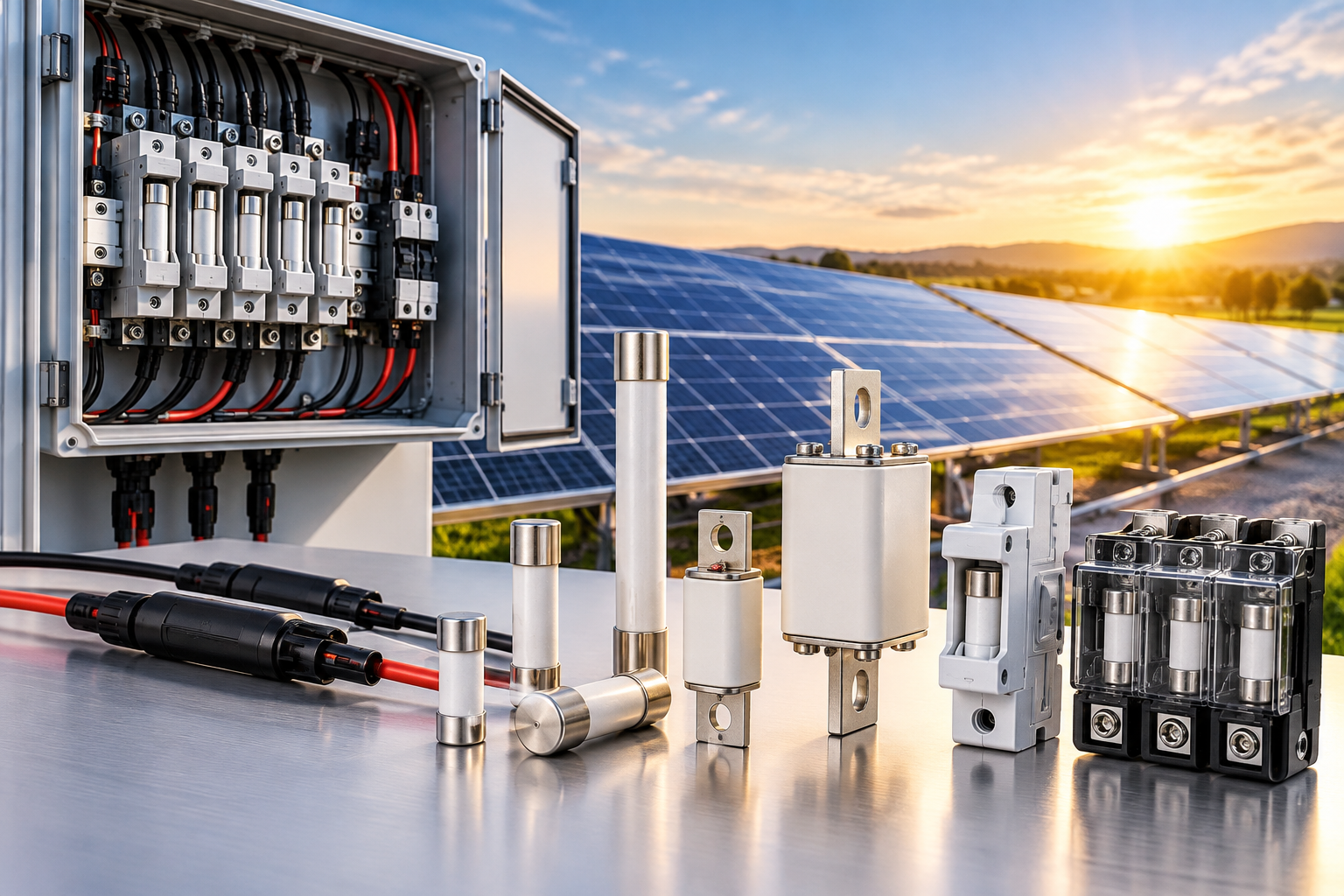
Solar photovoltaic (PV) systems require reliable electrical protection to ensure safe operation, prevent equipment damage, and maintain long-term system performance. One of the most important protection components is the solar PV fuse. It protects photovoltaic modules, DC cables, combiner boxes, and other electrical components against overcurrent conditions caused by short circuits, reverse currents, and system faults.
However, selecting the right solar PV fuse involves more than simply matching its current rating to the output of a solar panel. Factors such as maximum DC system voltage, short-circuit current, ambient temperature, breaking capacity, and compatibility with the fuse holder must all be considered.
Choosing an incorrectly rated fuse can result in unnecessary fuse operation, inadequate fault protection, overheating, or even serious electrical hazards.
So, how do you select the right solar PV fuse for your photovoltaic installation?
This guide explains the essential factors to consider when choosing a photovoltaic fuse and provides practical steps to help you make an informed selection.
1. Understand the Role of a Solar PV Fuse
A solar PV fuse is a protective electrical device designed specifically for photovoltaic DC applications. Its primary function is to interrupt excessive current when a fault occurs, preventing damage to solar modules, cables, and connected electrical equipment.
Unlike conventional AC circuits, DC circuits do not have a natural current zero-crossing point. Consequently, interrupting DC fault current requires a fuse specifically designed and rated to extinguish the electrical arc safely.
A photovoltaic fuse is commonly installed in a solar combiner box, where multiple PV strings are connected in parallel.
Its main protection functions include:
-
Overcurrent protection: Interrupts excessive current caused by electrical faults.
-
Reverse current protection: Helps prevent damaging reverse current from parallel-connected PV strings.
-
Equipment protection: Reduces the risk of damage to solar modules, DC cables, and other system components.
-
Fire risk reduction: Helps minimise overheating and electrical hazards caused by excessive fault current.
For photovoltaic installations, gPV fuses are commonly used because they are specifically designed for solar DC circuit protection.
2. Check the Maximum DC Voltage Rating
The first step in selecting a solar PV fuse is determining the maximum operating voltage of the photovoltaic system.
The fuse's rated DC voltage must be equal to or higher than the maximum possible system voltage under the expected operating conditions.
In solar installations, the most important value to consider is the open-circuit voltage (Voc) of the PV string at the lowest expected ambient temperature.
Solar panel voltage increases as temperature decreases. Therefore, using the nominal voltage listed under standard test conditions may result in an incorrect fuse selection.
How to Calculate Maximum PV System Voltage
To determine the maximum string voltage, consider:
-
Open-circuit voltage (Voc) of an individual solar module.
-
Number of modules connected in series.
-
Temperature coefficient of Voc.
-
Lowest expected ambient temperature at the installation site.
The basic calculation is:
Maximum String Voltage = Module Voc × Number of Modules in Series × Temperature Correction Factor
For example, if a solar module has an open-circuit voltage of 45V and 20 modules are connected in series, the nominal string open-circuit voltage is:
45V × 20 = 900V
The actual maximum voltage must then be adjusted for the lowest expected temperature.
If the corrected maximum voltage exceeds 1000V DC, a fuse rated for 1500V DC or another suitable higher voltage class may be necessary.
Important Voltage Selection Considerations
-
For systems with a maximum voltage up to 1000V DC, select a suitably rated 1000V DC photovoltaic fuse.
-
For systems operating above 1000V DC and up to 1500V DC, select a fuse specifically rated for 1500V DC.
-
For higher-voltage installations, verify that the fuse is designed and certified for the actual system voltage.
-
Never use an AC-rated fuse as a substitute for a DC-rated photovoltaic fuse.
Key takeaway: Always select the fuse according to the maximum corrected DC system voltage, not simply the nominal voltage of the solar installation.
3. Calculate the Correct Fuse Current Rating
Current rating is another critical factor in solar PV fuse selection.
The fuse must carry the expected operating current without unnecessary interruption while providing effective protection against excessive fault current.
The primary electrical parameter used for photovoltaic fuse sizing is the short-circuit current (Isc) of the solar module.
A commonly used sizing approach in applicable North American installations is:
Fuse Rating = Isc × 1.56
The multiplier of 1.56 combines two 1.25 factors to account for continuous operation and increased solar irradiance under the relevant sizing methodology.
However, the exact sizing requirements depend on the applicable electrical code, installation conditions, and fuse manufacturer's specifications. Other standards and project requirements may use different calculation methods.
Solar PV Fuse Sizing Example
Assume the following module specifications:
-
Module short-circuit current (Isc): 11.2A
-
Current sizing multiplier: 1.56
The calculation is:
11.2A × 1.56 = 17.47A
The next suitable standard fuse rating may be 20A.
However, selecting a 20A fuse does not automatically mean it is suitable. You must also confirm that:
-
The selected fuse meets the applicable electrical protection requirements.
-
Its rating does not exceed the maximum series fuse rating specified by the solar module manufacturer.
-
Its temperature-adjusted current capacity is adequate.
-
Its breaking capacity is suitable for the prospective fault current.
Common Solar PV Fuse Ratings
Common photovoltaic fuse ratings include:
-
10A
-
15A
-
20A
-
25A
-
30A
The appropriate rating depends on the module specifications, string configuration, system voltage, and installation conditions.
Important: Never select a solar fuse based on current alone. A fuse with an excessively high current rating may fail to provide adequate protection, while an undersized fuse may operate unnecessarily during normal system operation.
4. Consider Temperature Derating
Temperature is an important factor that can affect the performance of a solar PV fuse.
Photovoltaic fuses are frequently installed inside solar combiner boxes, which may experience elevated internal temperatures due to direct sunlight, limited ventilation, and heat generated by electrical components.
As ambient temperature increases, the fuse's continuous current-carrying capability can decrease.
This means that a fuse rated at 20A under specified reference conditions may not safely carry 20A continuously inside a hot enclosure.
Why Is Temperature Derating Important?
Ignoring temperature effects can lead to:
-
Unnecessary fuse operation.
-
Excessive heat generation.
-
Increased contact resistance.
-
Reduced electrical component lifespan.
-
Potential damage to the fuse holder and surrounding equipment.
How to Apply Temperature Derating
The appropriate derating factor must be obtained from the fuse manufacturer's technical datasheet.
For illustration, consider a fuse with a nominal current rating of 20A and an applicable temperature derating factor of 0.85.
The temperature-adjusted current capability is:
20A × 0.85 = 17A
This means the fuse's adjusted current-carrying capability under the assumed conditions is 17A.
If the expected continuous operating current exceeds this value, the selection must be reviewed.
The actual suitability of the fuse must be verified using its specified operating characteristics and applicable installation requirements.
Factors Affecting Temperature Derating
When selecting a solar PV fuse, consider:
-
Maximum ambient temperature.
-
Internal combiner box temperature.
-
Enclosure ventilation.
-
Fuse holder temperature characteristics.
-
Continuous operating current.
-
Cable and terminal temperature ratings.
Tip: Always use the manufacturer's temperature correction data rather than applying a general derating factor to every photovoltaic fuse.
5. Check the Breaking Capacity and Interrupting Rating
Breaking capacity is one of the most important safety considerations when selecting a solar PV fuse.
It refers to the maximum prospective fault current that a fuse can safely interrupt at its specified voltage under defined test conditions.
When a short circuit occurs in a photovoltaic system, the fault current may be supplied by multiple parallel-connected strings or other connected DC sources.
The selected fuse must be capable of interrupting the maximum prospective fault current without rupturing, sustaining an electrical arc, or causing further damage.
What Should You Check?
Before selecting a photovoltaic fuse, verify:
-
Maximum prospective short-circuit current.
-
Rated DC breaking capacity.
-
Maximum system voltage.
-
Fuse operating characteristics.
-
Applicable testing and certification requirements.
The breaking capacity must be sufficient for the actual fault conditions of the installation.
A fuse with an appropriate current rating but insufficient DC breaking capacity may not provide safe fault interruption.
Therefore, breaking capacity should always be checked alongside voltage and current ratings.
6. Verify I²t Coordination With Connected Equipment
Another important consideration is the energy let-through characteristic of a solar PV fuse, commonly expressed as I²t.
I²t represents the thermal energy associated with current flowing through the fuse during its operation.
It is particularly relevant when coordinating protective devices with sensitive electronic components, such as inverter power semiconductors.
During a fault, excessive energy let-through may damage connected equipment before the fuse completely interrupts the fault current.
How to Check I²t Coordination
To verify suitable coordination:
-
Obtain the inverter manufacturer's permissible I²t withstand data for the relevant circuit.
-
Check the fuse manufacturer's pre-arcing and total clearing I²t values.
-
Evaluate the prospective fault current at the installation point.
-
Confirm that the fuse's total clearing energy is within the withstand limits of the equipment being protected.
-
Review the coordination margin under the expected fault conditions.
The fuse's total clearing I²t should be appropriately coordinated with the withstand capability of the protected components.
This is especially important in large commercial and utility-scale photovoltaic installations where DC fault protection requirements can be more demanding.
7. Choose the Correct Fuse Type and Standard
Not all electrical fuses are suitable for solar photovoltaic applications.
A conventional fuse may not provide the necessary DC arc interruption performance or meet the specific operating requirements of a PV installation.
For this reason, gPV fuses are widely used in photovoltaic systems.
What Is a gPV Fuse?
A gPV fuse is a full-range photovoltaic fuse designed for protecting DC circuits in solar power installations.
It is intended to provide protection against both overload and short-circuit currents within its specified operating characteristics.
Common applications include:
-
Solar string protection.
-
PV combiner boxes.
-
Commercial solar installations.
-
Industrial photovoltaic systems.
-
Utility-scale solar farms.
Relevant Standards
When selecting a solar PV fuse, check the applicable standards and certification requirements.
IEC 60269-6 is an important international standard covering supplementary requirements for fuse-links used to protect solar photovoltaic energy systems.
Depending on the installation location, additional national electrical codes and certification requirements may also apply.
Always confirm that the fuse is tested and certified for the intended photovoltaic application.
8. Ensure Compatibility Between the Fuse and Fuse Holder
Selecting the correct fuse link is only part of the process. The fuse holder must also be compatible with the selected fuse.
Even when two components have similar physical dimensions, they may not provide the same electrical or thermal performance.
An incompatible combination can cause poor electrical contact, increased resistance, excessive temperature rise, and unreliable operation.
Important Fuse Holder Compatibility Checks
1. Physical Dimensions
Check the fuse body's length, diameter, and overall dimensions to ensure it fits correctly inside the holder.
2. Contact Configuration
Confirm that the fuse terminals, end caps, or blade contacts match the holder's contact arrangement.
3. Voltage Rating
The fuse holder must be suitable for the maximum DC voltage of the photovoltaic system.
4. Current Rating
Verify that the holder can continuously carry the required current under the actual installation conditions.
5. Thermal Performance
Consider the holder's temperature rise, heat dissipation, and operating environment.
6. Standards and Certification
Check that both the fuse link and holder meet the relevant technical and certification requirements.
Using a properly matched fuse and holder combination helps improve electrical reliability and reduce the risk of overheating.
9. Determine Whether String-Level Fuse Protection Is Required
The number of parallel-connected PV strings is another important consideration when selecting solar PV fuses.
When multiple strings are connected in parallel, current from the other strings may flow backward into a faulty string under certain fault conditions.
This reverse current can exceed the maximum current that a solar module or its internal connections can safely withstand.
Individual string fuses help interrupt this current and protect the affected string.
When Are Solar String Fuses Required?
The requirement depends on:
-
Number of parallel-connected strings.
-
Maximum possible reverse current.
-
Solar module maximum series fuse rating.
-
String configuration.
-
Applicable electrical codes.
-
System protection design.
In some configurations with only one or two parallel strings, individual string fuses may not be necessary.
However, this must be verified through the applicable protection calculations and electrical regulations.
Never assume that every solar installation requires the same number of fuses.
10. Common Mistakes to Avoid When Selecting Solar PV Fuses
Choosing the wrong photovoltaic fuse can compromise the safety and reliability of an entire solar power system.
Here are some common mistakes to avoid.
Using an AC Fuse in a DC Solar Circuit
AC and DC circuits have different arc interruption characteristics. Always select a fuse specifically rated for the required DC application.
Ignoring Maximum System Voltage
Selecting a fuse based on nominal system voltage without considering the temperature-corrected open-circuit voltage can result in inadequate protection.
Choosing the Wrong Current Rating
An undersized fuse may operate unnecessarily, while an oversized fuse may not provide sufficient protection.
Ignoring Temperature Derating
High temperatures inside combiner boxes can reduce the continuous current-carrying capability of a fuse.
Overlooking Breaking Capacity
The fuse must safely interrupt the maximum prospective fault current at the actual system voltage.
Using Incompatible Fuse Holders
A mismatched fuse link and holder can cause poor contact, overheating, and unreliable electrical performance.
Ignoring Manufacturer Specifications
The solar module's maximum series fuse rating and the electrical characteristics of connected equipment must always be considered.
Avoiding these mistakes helps ensure that the selected photovoltaic fuse provides reliable protection throughout the operating life of the solar installation.
11. Solar PV Fuse Selection Checklist
Before finalising your solar PV fuse selection, review the following checklist:
-
Confirm the maximum DC system voltage.
-
Calculate the maximum PV string open-circuit voltage at the lowest expected temperature.
-
Check the module short-circuit current (Isc).
-
Calculate the required fuse current rating according to the applicable standard.
-
Confirm that the selected fuse does not exceed the module's maximum series fuse rating.
-
Consider temperature derating inside the combiner box.
-
Verify the DC breaking capacity.
-
Check I²t coordination with protected equipment where required.
-
Confirm that the fuse is designed for photovoltaic DC applications.
-
Verify fuse holder dimensions and terminal compatibility.
-
Check applicable standards and certification requirements.
-
Confirm whether individual string fuses are required.
Following these steps will help you select a photovoltaic fuse that meets the electrical and environmental requirements of your solar installation.
Frequently Asked Questions About Solar PV Fuse Selection
1. What Type of Fuse Is Used in Solar PV Systems?
A gPV fuse is commonly used in solar photovoltaic systems. It is specifically designed for DC circuit protection in PV applications and helps protect solar modules, strings, cables, and associated equipment against overload and short-circuit currents.
2. How Do I Calculate the Correct Solar PV Fuse Size?
A commonly used sizing approach in applicable North American installations is to multiply the solar module's short-circuit current (Isc) by 1.56.
For example, if the module Isc is 10A:
10A × 1.56 = 15.6A
A suitable standard rating may be 20A, provided it meets the module's maximum series fuse rating, applicable electrical code requirements, and temperature-related operating conditions.
Always verify the correct sizing method for your installation.
3. Can I Use a 1000V DC Fuse in a 1500V Solar System?
No. A 1000V DC fuse must not be used in a system where the maximum voltage exceeds its rated DC interrupting voltage.
A 1500V DC photovoltaic system requires a fuse specifically rated for the maximum system voltage, including the temperature-corrected open-circuit voltage.
4. Why Are gPV Fuses Used in Solar Installations?
gPV fuses are designed specifically for photovoltaic DC applications. They provide protection against overload and short-circuit currents and are engineered to interrupt DC fault current safely within their rated operating conditions.
5. Does Temperature Affect Solar PV Fuse Selection?
Yes. High ambient temperatures can reduce a fuse's current-carrying capability.
Since solar combiner boxes can become significantly hotter than the surrounding outdoor environment, temperature derating must be considered during fuse selection.
6. What Happens If the Solar PV Fuse Rating Is Too High?
An oversized fuse may fail to provide adequate protection to solar modules, cables, and other components during an overcurrent condition.
It is important to ensure that the selected fuse rating does not exceed the permitted maximum series fuse rating of the solar module and satisfies the applicable protection requirements.
7. What Is the Difference Between a Solar PV Fuse and a Conventional Fuse?
A solar PV fuse is specifically designed and tested for photovoltaic DC applications. Its voltage rating, arc-quenching performance, and operating characteristics are suitable for the intended solar circuit.
A conventional fuse may not have the necessary DC voltage and breaking capacity ratings for safe use in a PV system.
8. Do All Solar Panels Need Individual Fuses?
Not necessarily. Individual string fuses are generally required when parallel-connected strings can produce reverse currents that exceed the permissible limits of the modules or associated conductors.
The requirement depends on the system configuration, module specifications, and applicable electrical regulations.
Conclusion
Selecting the right solar PV fuse is essential for maintaining the safety, reliability, and performance of a photovoltaic installation.
The selection process should begin with the maximum DC system voltage, followed by current rating calculations, temperature derating, breaking capacity verification, and compatibility checks with the fuse holder.
It is equally important to consider the solar module's maximum series fuse rating, prospective fault current, and coordination with connected electrical equipment.
A properly selected gPV fuse helps protect photovoltaic modules and associated electrical components against potentially damaging fault conditions while supporting reliable long-term system operation.
By following the selection principles and checklist outlined in this guide, solar installers, electrical engineers, and system designers can make more informed decisions when choosing photovoltaic fuses for residential, commercial, and utility-scale solar installations.



