
Eaton Bussmann Series Fuses: Technical FAQs and Expert Guide to Fuse Selection
Choosing the right fuse is essential for reliable electrical circuit protection, equipment safety and efficient system performance. Eaton Bussmann series fuses are designed for a wide range of electrical protection applications, but selecting the correct fuse requires an understanding of key technical factors, including breaking capacity, I²t ratings, voltage requirements, operating temperature and time-current characteristics.
Eaton’s Bussmann series Fuses Technical FAQs provide valuable guidance on these topics, helping engineers, electrical installers and maintenance professionals make informed decisions when specifying and applying fuses.
In this guide, we explore the most important technical questions about Eaton Bussmann series fuses, explain the terminology behind fuse selection and highlight the factors to consider when choosing the right circuit protection solution.
What Are Eaton Bussmann Series Fuses?
Eaton Bussmann series fuses are electrical protection devices used to interrupt excessive current caused by overloads or short circuits. By disconnecting a faulty circuit, a correctly selected fuse helps protect electrical equipment, wiring and other system components from potentially damaging fault conditions.
Fuses are used across industrial installations, electrical distribution systems, control panels, motor circuits and power electronics. Depending on the application, different fuse types offer different operating speeds, current ratings, voltage ratings and levels of fault-current protection.
Selecting the appropriate fuse involves more than matching the current rating. Engineers must also consider the available short-circuit current, the equipment being protected, the operating environment and the relevant electrical standards.
1. What Is Fuse Breaking Capacity?
Breaking capacity, also known as interrupting capacity, is the maximum fault current a fuse can safely interrupt at its specified voltage and under the applicable test conditions.
For example, if a fuse has a breaking capacity of 100 kA, its rating indicates that it can safely interrupt a fault current up to that level under the specified conditions.
When selecting an Eaton Bussmann series fuse, the breaking capacity must be equal to or greater than the prospective short-circuit current at the installation point. Using a fuse with insufficient breaking capacity can compromise the safety and reliability of the electrical system.
Key consideration: Always assess the available fault current and verify the fuse's breaking capacity at the intended operating voltage.
2. What Does I²t Mean in Fuse Technology?
I²t is an important parameter in electrical fuse selection. It represents the integral of current squared over time and is commonly used to describe the thermal energy associated with a fuse's operation.
The I²t value helps engineers assess how a fuse responds to fault currents and how much thermal stress may be imposed on protected components during a fault.
When selecting a fuse, it is important to compare the relevant fuse I²t data with the withstand characteristics of the equipment being protected. For current-limiting applications, the total clearing I²t can be particularly important because it accounts for the energy let through while the fuse interrupts the fault.
The correct comparison depends on the application, the type of I²t value specified and the equipment manufacturer's limits.
Why it matters: Appropriate I²t coordination can help reduce thermal damage to cables, semiconductor devices and other sensitive electrical components.
3. Why Is Fuse Watts Loss Important?
Fuse watts loss refers to the electrical power dissipated as heat when current flows through a fuse during normal operation.
Although some heat generation is unavoidable, excessive watts loss can increase temperatures inside electrical enclosures and distribution panels. It can also contribute to energy losses in continuously operating installations.
When comparing Eaton Bussmann series fuse options, engineers should review the published watts loss data alongside the current rating and application requirements.
This is particularly important in installations with multiple fuses, limited ventilation or high continuous operating currents.
Practical tip: Consider watts loss during the design stage to help manage panel temperatures, energy efficiency and the thermal performance of the overall installation.
4. What Is the M-Effect in Fuses?
The M-Effect refers to the use of a lower-melting-point alloy at a specific location on a fuse element. This feature can influence how the element responds to sustained overload currents.
By modifying the melting behaviour of the element, the M-Effect can help a fuse operate under particular overload conditions without relying solely on an extremely thin conductor.
Its application depends on the fuse design and intended operating characteristics. The M-Effect is therefore one of several factors that distinguish different fuse technologies and operating classes.
Understanding the fuse element design can help engineers identify products suitable for their required overload and short-circuit protection characteristics.
5. How Does Ambient Temperature Affect Fuse Performance?
Ambient temperature can influence fuse operating behaviour because the fuse element generates heat during normal current flow.
In environments with elevated temperatures, the fuse may operate differently from how it performs under standard reference conditions. High temperatures can also affect service life and the thermal conditions inside electrical enclosures.
Applications involving industrial machinery, enclosed control panels or demanding environmental conditions should therefore include an assessment of ambient temperature and heat dissipation.
Depending on the specific fuse, operating conditions and manufacturer's data, a derating factor may be necessary.
Before installation, check:
-
The expected ambient temperature range.
-
The manufacturer's current derating guidance.
-
The enclosure's ventilation and heat dissipation.
-
The fuse holder's ratings and thermal limitations.
-
Any relevant environmental or application-specific requirements.
Always use the product-specific technical documentation when determining the appropriate fuse rating.
6. Which Standards Apply to Eaton Bussmann Series Fuses?
Electrical fuse standards help establish requirements for construction, performance, testing and safe application.
IEC 60269 is a key international standard series for low-voltage fuses. Depending on the market and application, other national or regional standards may also apply. North American installations may require appropriately UL Listed or UL Recognised products, depending on the equipment design and applicable requirements.
When specifying a fuse, verify that its certification and standard compliance match the intended installation.
This is particularly important for original equipment manufacturers, panel builders and businesses exporting electrical equipment internationally.
7. What Is Arc Flash, and How Can Fuse Selection Help?
An arc flash is a hazardous release of energy caused by an electrical arc. It can generate intense heat, light, pressure and molten material, potentially causing severe injuries and equipment damage.
Correctly selected current-limiting fuses can help reduce fault energy under suitable conditions by limiting the current and interrupting the fault rapidly. However, the actual reduction in arc-flash risk depends on the system design, fault conditions, protective-device characteristics and clearing time.
Fuse selection should form part of a broader electrical safety strategy that includes appropriate system design, maintenance procedures, risk assessment and suitable protective equipment.
Important: Never assume that installing a fuse makes live electrical work safe. Follow applicable electrical safety procedures and use qualified personnel.
8. What Is the Difference Between gFF, gG, gR, aM and aR Fuses?
Fuse operating categories describe the intended protection function and operating characteristics of different fuse types.
The correct category depends on the equipment being protected and the nature of the expected overloads and short circuits.
-
gFF: A fast-acting full-range fuse category, where specified by the applicable product standard and manufacturer.
-
gG: A general-purpose full-range fuse commonly used for cable and general circuit protection.
-
gR: A full-range semiconductor protection category intended for applications requiring suitable protection of power semiconductor devices.
-
aM: A partial-range motor-circuit fuse category primarily intended for short-circuit protection and normally used with separate overload protection.
-
aR: A partial-range semiconductor protection category designed for rapid interruption of high fault currents in suitable applications.
These categories are not interchangeable. In particular, partial-range aM and aR fuses generally require additional protection to address overload conditions outside their intended operating range.
When choosing an Eaton Bussmann series fuse, consult the product datasheet and the relevant application guidance rather than relying on the category designation alone.
9. What Is the Difference Between 415 V AC and 690 V AC Fuses?
The voltage rating indicates the maximum voltage under which a fuse is designed to interrupt current in accordance with its specifications.
A 415 V AC fuse must not be used in an application where the required operating voltage exceeds its rated voltage. A suitably rated 690 V AC fuse may be suitable for a lower-voltage application, provided all other electrical and installation requirements are met.
However, a higher voltage rating does not automatically make a fuse the best choice. Engineers must also check current rating, breaking capacity, operating characteristics, physical dimensions and compatibility with the fuse holder or switch-fuse assembly.
Selection rule: Confirm the system voltage and ensure that the fuse's voltage rating and interrupting capability are appropriate for the actual installation.
10. What Is the Difference Between AC and DC Fuses?
Alternating current (AC) periodically changes direction, while direct current (DC) flows in one direction under normal operating conditions.
This difference affects how a fuse interrupts a fault. In an AC circuit, the current naturally passes through zero during each cycle, which can help the fuse extinguish the arc. DC circuits do not have the same regular current-zero crossings, making arc interruption more challenging in many applications.
For this reason, DC fuse selection requires particular attention to the rated DC voltage, prospective fault current, circuit characteristics and the manufacturer's specified interruption capability.
Never assume that an AC fuse is suitable for DC operation simply because its current rating appears appropriate.
For photovoltaic systems, battery storage, electric vehicles and other DC applications, select a fuse specifically rated for the intended DC conditions.
11. What Does a Fuse Time-Current Curve Show?
A time-current characteristic curve illustrates the relationship between the current flowing through a fuse and the time it takes to operate.
In general, higher fault currents cause a fuse element to operate more quickly, while lower overload currents may take longer to interrupt.
Engineers use these curves to evaluate whether a fuse is appropriate for the expected load profile and fault conditions. They can also help assess coordination between protective devices and reduce the risk of unnecessary interruptions during normal operation or equipment starting.
When reviewing a time-current curve, consider:
-
Normal operating current and expected load variations.
-
Motor starting currents or other temporary inrush conditions.
-
The required overload and short-circuit response.
-
Coordination with upstream and downstream protective devices.
-
The distinction between minimum melting time and total clearing time.
Always refer to the specific fuse's published curves and technical data when designing a protection scheme.
12. What Is the Difference Between Offset and Centre Bolted Tags?
Bolted tags are connection terminals used to mount a fuse securely within an electrical assembly.
Offset bolted tags are positioned away from the centre line of the fuse. They may be used in distribution boards, electrical panels, fuse holders and switch-fuse assemblies designed for this configuration.
Centre bolted tags are aligned with the fuse's centre line and may be suitable for assemblies such as connections between copper busbars, where the physical arrangement requires this design.
The correct terminal configuration depends on the equipment layout, available mounting space and the compatibility of the fuse with the associated holder or assembly.
Before ordering a replacement fuse, check the overall dimensions, fixing-hole arrangement, tag position and product reference to ensure a correct fit.
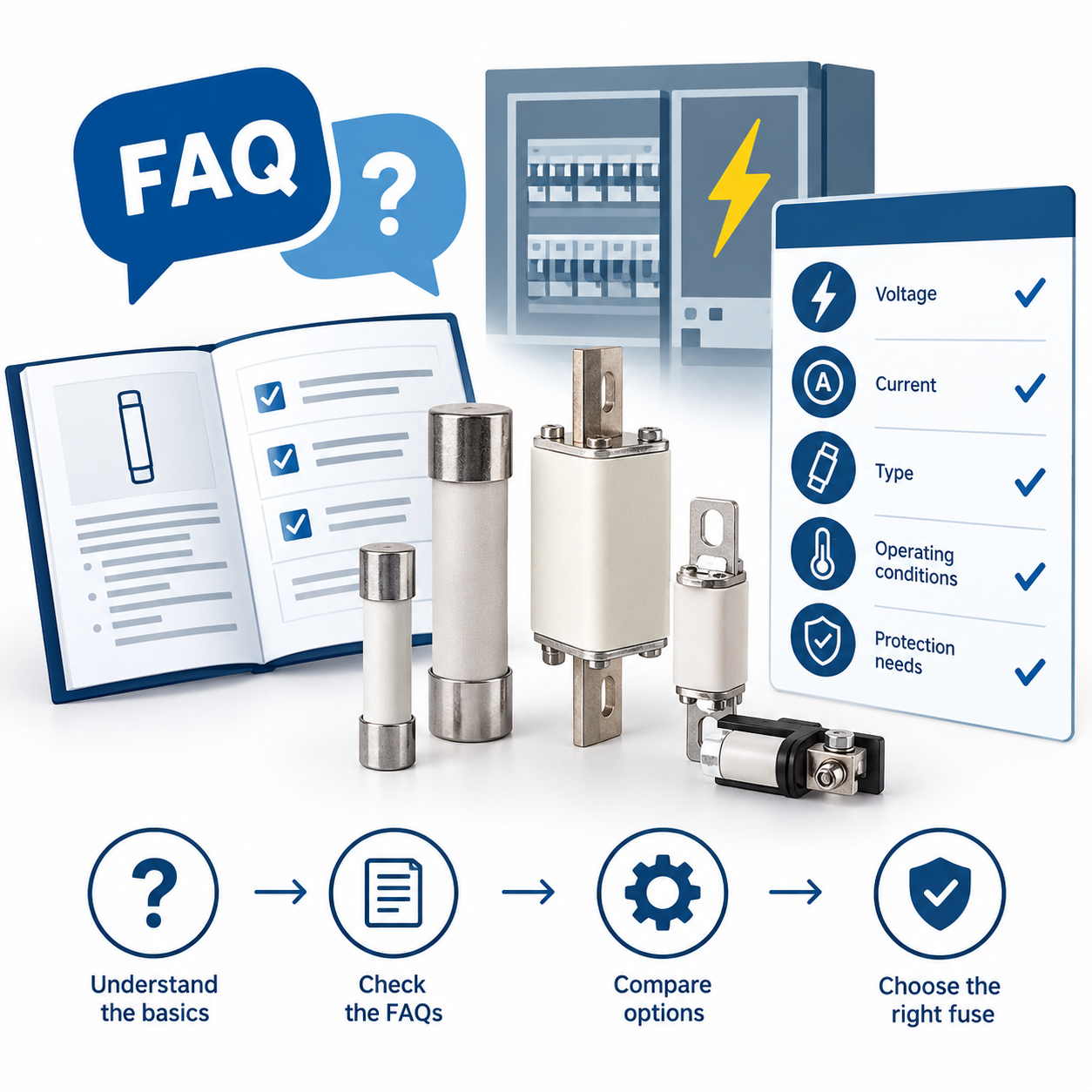
How to Choose the Right Eaton Bussmann Series Fuse
Selecting the right fuse starts with a clear understanding of the circuit, the load and the level of protection required.
Use the following checklist when evaluating fuse options:
-
Determine the operating voltage. Confirm the required AC or DC rating.
-
Establish the normal operating current. Account for continuous load, inrush current and relevant operating conditions.
-
Calculate the prospective short-circuit current. Confirm that the fuse's breaking capacity is adequate.
-
Identify the required protection category. Match the fuse type to the application, such as general circuit, motor or semiconductor protection.
-
Review I²t and time-current characteristics. Check coordination and the withstand limits of protected equipment.
-
Assess the thermal environment. Consider ambient temperature, watts loss, ventilation and derating requirements.
-
Verify physical compatibility. Check dimensions, bolted tags, fuse holders and mounting arrangements.
-
Confirm standards and certification. Ensure compliance with the requirements of the intended market and installation.
Where the application is complex or the consequences of incorrect selection are significant, consult the manufacturer's technical documentation or seek advice from a qualified fuse application specialist.
Frequently Asked Questions About Eaton Bussmann Series Fuses
How do I know which Eaton Bussmann fuse I need?
Identify the system voltage, normal load current, prospective short-circuit current, required protection function and installation conditions. Then compare these requirements with the manufacturer's fuse ratings, datasheets and time-current characteristics.
Can I use a higher-rated voltage fuse in a lower-voltage system?
A fuse with a higher voltage rating may be suitable for a lower-voltage system if its other ratings, operating characteristics, physical configuration and application requirements are also appropriate. Always verify the manufacturer's specifications.
Why is breaking capacity important?
Breaking capacity determines the maximum fault current a fuse can safely interrupt under specified conditions. The rating must be adequate for the prospective short-circuit current at the point of installation.
What is the difference between gG and aM fuses?
A gG fuse provides full-range general-purpose protection against overloads and short circuits within its rated application. An aM fuse is intended primarily for short-circuit protection in motor circuits and generally requires separate overload protection.
Do DC applications require special fuses?
Yes. A fuse must have a suitable DC voltage rating and interrupting capability for the circuit in which it is used. DC fault interruption can be more demanding than AC interruption, so product-specific ratings are essential.
Where can I find official Eaton Bussmann series fuse technical information?
Eaton provides technical FAQs, product datasheets and application resources to support fuse selection.
Conclusion: Make Informed Decisions About Fuse Selection
Understanding fuse breaking capacity, I²t, watts loss, ambient temperature, operating categories and time-current curves is essential for selecting effective electrical circuit protection.
Eaton Bussmann series fuses offer different protection characteristics for different applications, making it important to evaluate each installation individually. By checking the electrical ratings, environmental conditions, equipment requirements and applicable standards, engineers and installers can make better-informed decisions about fuse selection.
For more detailed technical explanations, consult Eaton's official Fuses Technical FAQs and the datasheet for the specific fuse being considered.
Need help selecting the right fuse? Visit Eaton's technical resources or contact its fuse technical support team for application-specific guidance.