
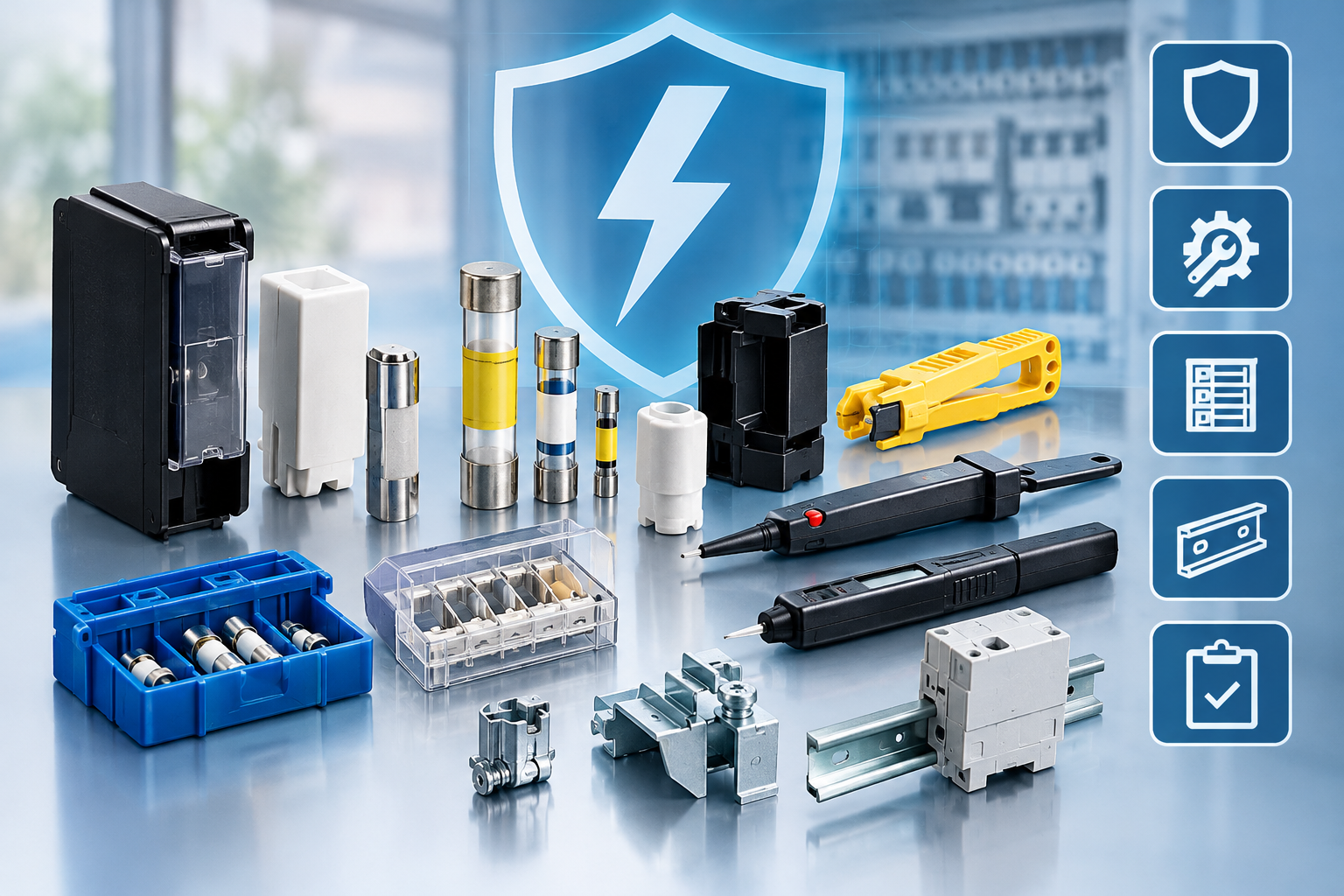
 bus-ele-cat-1007-flc-2018-sec-15-accesories.pdf bus-ele-cat-1007-flc-2018-sec-15-accesories.pdf | [Eaton Bussmann series Full line catalog: Accessories] | 2354 kB |
Eaton Bussmann Series Full Line Catalog: Accessories – A Complete Guide to Fuse Accessories
Introduction to Eaton Bussmann Series Fuse Accessories
Reliable electrical circuit protection involves more than selecting the right fuse. Choosing compatible accessories is equally important for supporting safe installation, efficient maintenance, and dependable electrical system operation. The Eaton Bussmann Series Full Line Catalog 1007 – Accessories, Section 15 provides an overview of accessories designed to complement Bussmann series fuses and related electrical protection equipment.
Published as part of the October 2018 full line catalog, this section covers a range of practical products, including fuse covers, fuse reducers, dummy fuse neutrals, fuse pullers, fuse testers, spare fuse holders, spare fuse cabinets, Tron clip clamps, and DIN-Rail adapters.
For electrical engineers, maintenance technicians, panel builders, industrial buyers, and electrical distributors, understanding these accessories can help simplify product selection and support effective circuit protection system maintenance.
What Does the Eaton Bussmann Accessories Catalog Cover?
The Eaton Bussmann Series accessories catalog focuses on products that support fuse handling, installation, storage, and compatibility with specific fuse classes and applications.
The main product categories include:
-
SAMI fuse covers for selected fuse classes
-
Fuse reducers for Class J, H(K), and R applications
-
Dummy fuse neutrals for specified fuse configurations
-
Fuse pullers for handling fuses
-
Fuse testers for checking fuse condition
-
Spare fuse holders for replacement fuse storage
-
Spare fuse cabinets for organized inventory management
-
Tron clip clamps for compatible electrical applications
-
DIN-Rail adapters for suitable mounting arrangements
These accessories address different practical requirements in electrical installations. Selecting the appropriate component depends on the fuse type, installation arrangement, applicable electrical ratings, and manufacturer specifications.
1. SAMI Fuse Covers: Supporting Electrical Installation Safety
SAMI fuse covers are listed for selected fuse classes, including Class CC, G, H(K), J, R, T, and UL supplemental midget fuses.
Fuse covers can help provide a suitable protective covering around compatible fuse installations. Depending on the product design and application, covers may help reduce exposure to accessible electrical components and support a more organized installation.
When selecting a fuse cover, it is important to verify the fuse class, physical dimensions, mounting arrangement, and compatibility with the intended fuse holder or equipment.
Key selection considerations:
-
Confirm the exact fuse class and compatible accessory.
-
Check the manufacturer's dimensional and installation requirements.
-
Verify that the selected component is suitable for the electrical enclosure and application.
-
Follow applicable electrical safety standards and installation instructions.
2. Fuse Reducers: Matching Compatible Fuse Configurations
Fuse reducers are another category featured in the Eaton Bussmann accessories section. The catalog identifies reducers for Class J, H(K), and R applications.
Fuse reducers are used in specific compatible configurations to accommodate differences in fuse and holder arrangements. Their suitability depends on the exact fuse system and the equipment in which they are installed.
Choosing the wrong reducer can create compatibility problems and may compromise the intended circuit protection arrangement. A reducer should never be selected based only on physical fit.
Before specifying a fuse reducer, verify the applicable fuse class, permitted electrical ratings, holder compatibility, and any restrictions identified by the manufacturer.
3. Dummy Fuse Neutrals: Accessories for Specific Fuse Systems
The catalog also includes dummy fuse neutrals for specified configurations, covering 1/4-inch × 1-1/4-inch fuses, UL supplemental midget fuses, and selected Class CC, H(K), and R applications.
These products are intended for particular compatible fuse-system arrangements. Their purpose and permitted use depend on the design of the electrical equipment and the manufacturer's instructions.
Dummy fuse neutrals should not be treated as universal substitutes for protective fuses. They must only be used where the equipment design and applicable instructions specifically permit them.
When identifying the correct component, check the exact catalog designation, fuse class, equipment requirements, and electrical safety provisions.
4. Fuse Pullers: Practical Tools for Fuse Maintenance
Fuse pullers are designed to assist with removing and handling compatible fuses. They can be useful in maintenance environments where technicians regularly inspect or replace protective devices.
Using an appropriate fuse-handling tool can help improve control during removal and reduce the likelihood of accidental contact with surrounding components. However, a fuse puller does not make an energized circuit safe to work on.
Before replacing a fuse, qualified personnel should follow the applicable isolation, lockout/tagout, and verification procedures. Equipment must be placed in a safe condition according to the relevant electrical safety requirements.
When choosing a fuse puller, consider:
-
Compatibility with the fuse's size and construction.
-
Accessibility within the fuse holder or enclosure.
-
The manufacturer's handling instructions.
-
The safety procedures required for the installation.
5. Fuse Testers: Supporting Fuse Inspection and Troubleshooting
Fuse testers are included in the Bussmann accessories catalog as tools for checking fuse condition.
A suitable tester can help maintenance personnel investigate a suspected open fuse and identify components that may require replacement. The correct testing method depends on the tester design and the electrical characteristics of the fuse.
Testing should be carried out using equipment suitable for the task and in accordance with the tester's instructions. Where necessary, the circuit must be isolated and the fuse removed before testing.
A fuse tester can assist with troubleshooting, but it does not replace a complete assessment of the electrical circuit. Repeated fuse failures may indicate an underlying problem, such as an overload, short circuit, incorrect fuse selection, or equipment fault.
6. Spare Fuse Holders: Keeping Replacement Fuses Organized
Spare fuse holders provide a practical way to keep replacement fuses available for maintenance and service work.
Having the correct replacement fuse readily accessible can reduce unnecessary downtime when a protective device needs to be changed. Organized spare storage also helps personnel distinguish between different fuse types and ratings.
When selecting spare fuse holders, consider the fuse dimensions, mounting requirements, storage environment, and the identification system used by the maintenance team.
Replacement fuses should always match the required specifications. Current rating alone is not sufficient: voltage rating, interrupting rating, time-current characteristics, fuse class, and application requirements may also be important.
7. Spare Fuse Cabinets: Improving Maintenance Readiness
The Eaton Bussmann accessories catalog includes spare fuse cabinets for organized fuse storage.
A dedicated cabinet can help centralize replacement stock and make it easier for maintenance teams to locate the appropriate fuse when required. This is particularly useful in industrial facilities, control panels, electrical workshops, and service departments that maintain multiple fuse types.
An effective spare fuse management process should include:
-
Clear identification of fuse types and ratings.
-
Separate storage for different fuse classes and applications.
-
Stock checks and replenishment procedures.
-
Protection against damage, contamination, and unsuitable storage conditions.
-
Verification of replacement fuse specifications before installation.
A well-organized spare fuse cabinet can support maintenance planning and help reduce delays caused by missing or incorrectly identified replacement parts.
8. Tron Clip Clamps: Accessories for Compatible Electrical Applications
Tron clip clamps are another product category listed in Section 15 of the Bussmann series catalog.
As with other electrical accessories, correct selection depends on the intended equipment, component dimensions, and the manufacturer's compatibility requirements. A product's appearance or physical fit should not be considered sufficient evidence that it is suitable for a particular installation.
Before specifying a clip clamp, consult the relevant catalog details and product documentation to confirm the correct application and installation method.
9. DIN-Rail Adapters: Supporting Suitable Mounting Arrangements
DIN-Rail adapters are included among the accessories covered in the Eaton Bussmann catalog.
DIN-Rail mounting is widely used in industrial control cabinets and electrical enclosures because it can simplify equipment arrangement and support modular installation practices. A compatible adapter can provide a mounting solution for equipment designed to use that accessory.
However, not every fuse holder or electrical component can be mounted using every DIN-Rail adapter. Mechanical compatibility, enclosure space, clearances, electrical ratings, and manufacturer instructions must all be considered.
For panel builders and control-system designers, confirming mounting compatibility early in the design process can help avoid installation difficulties and unnecessary component changes.
Benefits of Selecting the Right Bussmann Series Accessories
Choosing suitable accessories can improve several aspects of electrical system management.
Improved maintenance efficiency
Fuse pullers, testers, holders, and storage cabinets can help technicians organize inspection and replacement tasks. Easy access to correctly identified spare fuses can also support faster maintenance.
Better component compatibility
Accessories selected for the appropriate fuse class and equipment configuration help maintain the intended installation arrangement. Checking manufacturer specifications reduces the risk of selecting an unsuitable component.
More organized electrical installations
Compatible covers and mounting accessories can contribute to a structured installation when used according to the product instructions and applicable requirements.
More effective inventory management
Dedicated spare fuse storage and clear identification procedures can help reduce confusion between fuse types and ratings.
Support for reliable circuit protection
Accessories complement the fuse and its associated equipment. The overall protection system still depends on correct fuse selection, suitable installation, proper coordination, and compliance with applicable electrical requirements.
How to Choose the Correct Eaton Bussmann Fuse Accessory
Selecting an accessory should begin with the requirements of the actual electrical installation rather than the accessory category alone.
Follow these steps to support accurate product selection:
Step 1: Identify the installed fuse. Record the fuse class, catalog number, dimensions, current rating, voltage rating, and other relevant specifications.
Step 2: Define the accessory's purpose. Determine whether the requirement involves fuse handling, testing, storage, mounting, covering, or a specific compatible fuse configuration.
Step 3: Check compatibility. Consult the Eaton Bussmann catalog and applicable product documentation to confirm that the accessory is intended for the fuse and equipment involved.
Step 4: Review electrical and mechanical requirements. Verify relevant ratings, mounting arrangements, clearances, environmental conditions, and any installation limitations.
Step 5: Follow the manufacturer's instructions. Use the accessory only for its specified purpose and ensure installation and maintenance are carried out by appropriately qualified personnel.
Step 6: Verify current product information. Because the referenced full line catalog dates from October 2018, confirm current product availability, specifications, and any updated documentation before ordering or designing new equipment.
Who Can Benefit from the Eaton Bussmann Accessories Catalog?
The accessories section is a useful reference for several professional groups.
-
Electrical engineers: To investigate compatible accessory options during circuit protection design.
-
Panel builders: To check accessory requirements and mounting arrangements for electrical enclosures.
-
Maintenance technicians: To plan fuse testing, handling, replacement, and spare storage.
-
Industrial purchasing teams: To identify accessory categories and prepare more accurate procurement specifications.
-
Electrical distributors: To understand common accessory requirements and assist customers with product identification.
-
Facility managers: To support spare fuse organization and maintenance planning across electrical installations.
For each group, the main benefit is having a structured reference to the accessory categories associated with Bussmann series circuit protection products.
Frequently Asked Questions
What is the Eaton Bussmann Series Full Line Catalog Section 15?
Section 15 is the accessories section of Eaton's Bussmann Series Full Line Catalog 1007. The October 2018 edition covers accessories such as SAMI fuse covers, fuse reducers, dummy fuse neutrals, fuse pullers, fuse testers, spare fuse holders, spare fuse cabinets, Tron clip clamps, and DIN-Rail adapters.
Which fuse accessories are covered in the catalog?
The section lists accessories for selected fuse classes and configurations, including Class CC, G, H(K), J, R, and T, as well as certain UL supplemental midget fuses. It also includes handling tools, storage products, and mounting accessories.
How do I select the correct fuse accessory?
Start with the fuse's exact catalog number, class, dimensions, and electrical specifications. Then verify accessory compatibility using the manufacturer's documentation. Never assume that accessories are interchangeable simply because they appear to fit.
Why are fuse pullers and fuse testers useful?
Fuse pullers help with handling compatible fuses, while fuse testers assist with checking fuse condition. Both can support maintenance activities when used correctly and in accordance with electrical safety procedures.
Does the 2018 catalog guarantee that every listed accessory is still available?
No. The catalog is a historical product reference. Current availability, specifications, and replacement options should be confirmed with Eaton or an authorized distributor before purchasing.
Conclusion
The Eaton Bussmann Series Full Line Catalog 1007 – Accessories section provides a practical overview of accessories that support fuse handling, installation, testing, storage, and compatible mounting arrangements.
From SAMI fuse covers and fuse reducers to fuse pullers, testers, spare fuse cabinets, Tron clip clamps, and DIN-Rail adapters, these product categories address a variety of needs in industrial electrical systems and circuit protection applications.
For the best results, identify the installed fuse correctly, verify accessory compatibility, follow manufacturer instructions, and confirm current product information before ordering. Selecting the right accessories helps support organized maintenance, appropriate component installation, and reliable electrical protection practices.



