
 eaton-ev-fuse-catalogue-emob0062-en-us.pdf  | [Eaton Bussmann EV Fuses] | 0 kB |
Cylindrical vs Square Body Fuses for EV: Key Differences, Advantages and Applications
As electric vehicles (EVs) continue to evolve, electrical safety and circuit protection have become increasingly important in vehicle design. Modern EVs operate with high-voltage battery systems, powerful electric motors, advanced charging technologies, and sophisticated electronic components. Selecting the right fuse is therefore essential to ensure reliable operation, prevent electrical damage, and improve overall vehicle safety.
Among the commonly used fuse designs in electric vehicle applications are cylindrical fuses and square body fuses. Both provide overcurrent and short-circuit protection, but they differ in physical construction, mounting methods, current-handling capabilities, thermal performance, and installation requirements.
Understanding the differences between cylindrical and square body fuses can help EV manufacturers, electrical engineers, and system designers select the most suitable protection solution for their applications.
In this guide, we compare cylindrical vs square body fuses for EV applications, explore their advantages and limitations, and explain how to choose the right fuse for your electrical system.
1. What Are Cylindrical Fuses?
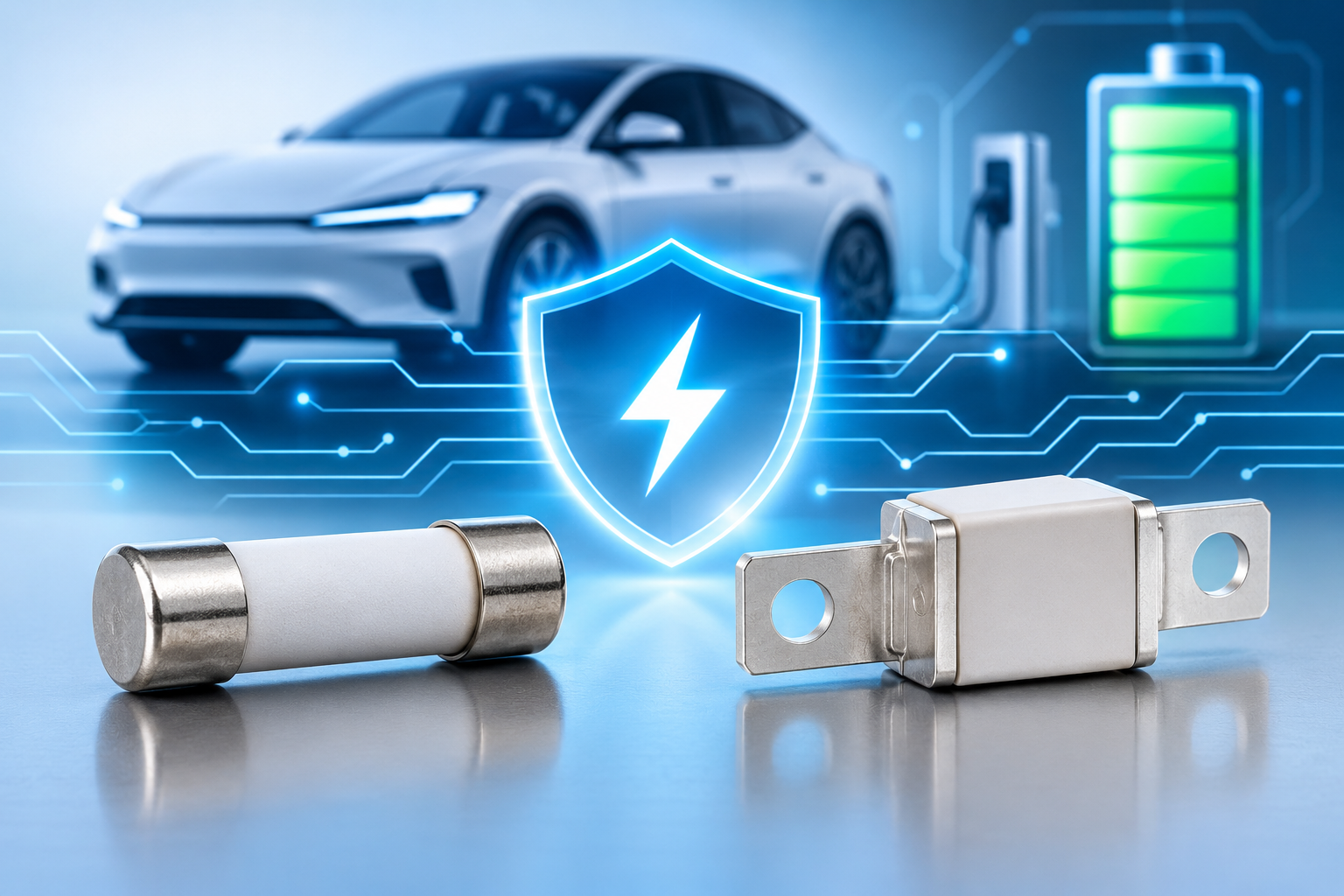
Cylindrical fuses are electrical protection devices featuring a round, tube-shaped body with metal end caps or ferrule contacts. They are designed to interrupt excessive current when an overload or short circuit occurs, protecting sensitive electrical components and circuits.
Due to their compact construction, cylindrical fuses are commonly used in applications where installation space is limited.
In electric vehicles, they can be installed in battery packs, charging modules, auxiliary electrical circuits, and other power distribution systems.
Key Features of Cylindrical Fuses
-
Compact design: Their round body allows installation in confined spaces and compact battery enclosures.
-
Flexible mounting options: Depending on the design, they can use clip-mounted holders or bolted connections.
-
Multiple size options: Common dimensions include 10×38 mm, 14×51 mm, and 22×58 mm.
-
Versatile applications: Suitable for auxiliary circuits, charging systems, and selected main battery protection applications.
-
Current flexibility: Available in different current ratings, with specialized EV designs supporting higher current levels.
Advantages of Cylindrical Fuses in EVs
The biggest advantage of cylindrical fuses is their space-saving construction. EV battery systems often have limited internal space, making compact protection components particularly valuable.
Bolted cylindrical fuse designs also provide reliable electrical connections and improved resistance to vibration compared with conventional clip-mounted installations.
For smaller electric vehicles, electric motorcycles, scooters, and compact battery systems, cylindrical fuses can offer an effective combination of size, performance, and installation flexibility.
2. What Are Square Body Fuses?
Square body fuses, commonly known as square blade or bolted NH-type fuses, feature a rectangular body with flat metal terminals at both ends.
These fuses are designed for electrical systems that require robust overcurrent protection, particularly in high-current applications.
Unlike conventional cylindrical fuses installed in clips, square body fuses are generally bolted directly onto busbars or electrical terminals. This creates a secure mechanical connection and supports effective heat transfer.
In electric vehicles, square body fuses are frequently considered for main battery protection, high-power DC circuits, and primary power distribution systems.
Key Features of Square Body Fuses
-
Robust construction: Their larger rectangular design supports demanding electrical applications.
-
Bolted installation: Flat terminals allow direct connection to busbars and power terminals.
-
High current capacity: Depending on the fuse series and size, they can support ratings exceeding 630A.
-
Thermal performance: Direct mounting and larger contact surfaces can help manage heat under sustained loads.
-
Fault indication: Certain designs include striker pins or other indicators for identifying fuse operation.
-
Standardized dimensions: Common NH sizes include NH00, NH1, NH2, and NH3.
Advantages of Square Body Fuses in EVs
Square body fuses are particularly suitable for high-power electric vehicle systems.
Their bolted connections help maintain stable electrical contact under vibration and mechanical stress. Their construction and busbar mounting arrangements can also support effective thermal management.
For commercial electric vehicles, heavy-duty trucks, and high-voltage battery systems, square body fuses can provide reliable protection for critical power circuits.
Some designs also offer striker-pin mechanisms that make it easier to identify an operated fuse and integrate fault indication into a monitoring system.
3. Cylindrical vs Square Body Fuses: Key Differences
Although both fuse types provide electrical protection, their different constructions make them suitable for different EV applications.
The following comparison highlights their main characteristics.
| Comparison Criteria | Cylindrical Fuses | Square Body Fuses |
|---|---|---|
| Physical design | Round, tube-shaped body | Rectangular body with flat terminals |
| Typical dimensions | 10×38, 14×51, 22×58 mm | NH00, NH1, NH2, NH3 |
| Current capacity | From low ratings to 250A or 400A in specialized designs | Approximately 32A to over 630A, depending on design |
| Mounting method | Clip-mounted or bolted | Generally bolted |
| Installation space | Compact | Requires more installation space |
| Thermal management | Depends on fuse design and holder contact | Benefits from direct busbar mounting and larger contact surfaces |
| Vibration resistance | Good with secure or bolted connections | High with properly installed bolted connections |
| Replacement | Clip types are relatively easy to replace; bolted types require tools | Requires tools to remove terminal bolts |
| Fault indication | Optional, depending on design | Striker-pin indication available in selected designs |
| Typical EV applications | Auxiliary circuits, charging modules, compact battery systems | Main battery protection, high-current DC links, power distribution |
It is important to note that actual electrical ratings, dimensions, and performance depend on the individual fuse design and manufacturer specifications.
4. Which Fuse Is Better for Electric Vehicles?
There is no universal answer to whether cylindrical or square body fuses are better for electric vehicles. The right choice depends on the electrical requirements, installation environment, available space, and protection objectives.
When Should You Choose Cylindrical Fuses?
Cylindrical fuses are generally a good choice when:
-
Installation space is limited.
-
The electrical system requires compact protection components.
-
The application involves auxiliary or branch circuit protection.
-
The vehicle has relatively low or moderate current requirements.
-
A bolted cylindrical design is needed for improved vibration resistance.
-
Weight and component layout are important design considerations.
For example, electric scooters and motorcycles often have compact battery enclosures. Cylindrical fuses can fit these environments more easily while providing the required circuit protection.
When Should You Choose Square Body Fuses?
Square body fuses are generally preferable when:
-
The application involves high continuous current.
-
Main battery or DC bus protection is required.
-
The fuse connects directly to a busbar.
-
The electrical system experiences significant vibration.
-
Effective thermal management is a major design priority.
-
Remote fault indication is required.
For example, heavy-duty electric trucks and commercial EVs often use high-capacity battery systems. Square body fuses can provide a suitable solution for protecting their main power circuits.
5. Four Important Factors When Selecting EV Fuses
Choosing between cylindrical and square body fuses requires more than comparing their physical dimensions. Engineers should evaluate several electrical and mechanical factors before making a final decision.
1. Current Rating and Electrical Requirements
The first consideration is the continuous operating current of the protected circuit.
For applications below approximately 200A, both cylindrical and square body fuse designs may be suitable, depending on their individual ratings and operating conditions.
For applications requiring 200A or more, square body fuses are commonly considered because of their robust construction and suitability for direct busbar mounting. However, specialized bolted cylindrical fuses can also support higher current ratings.
Always evaluate the fuse's rated current, time-current characteristics, breaking capacity, and operating conditions before selecting a suitable model.
2. Voltage Rating and Breaking Capacity
EV battery systems operate at high DC voltages, making voltage rating and DC breaking capacity critical selection factors.
The selected fuse must have an appropriate DC voltage rating and sufficient breaking capacity to safely interrupt the maximum prospective short-circuit current.
A fuse with an insufficient DC breaking capacity may fail to interrupt a fault safely.
Engineers should also consider voltage fluctuations, battery characteristics, and the electrical behavior of the complete protection system.
3. Thermal Performance
Heat generation is an important consideration in EV electrical systems.
When a fuse operates under continuous high current, electrical resistance and connection quality influence its temperature.
Cylindrical fuses have a relatively compact surface area, so proper holder selection and contact quality are especially important.
Square body fuses benefit from their bolted connections and larger contact interfaces, which can support heat transfer to connected busbars.
However, neither shape automatically guarantees better thermal performance. Actual results depend on the fuse construction, mounting arrangement, ambient temperature, ventilation, and installation conditions.
4. Vibration Resistance and Mechanical Stability
Electric vehicles experience continuous vibration during operation. Commercial vehicles and heavy-duty trucks may encounter even greater mechanical stress.
Loose electrical connections can increase contact resistance, generate excessive heat, and eventually lead to system failure.
Bolted cylindrical and square body fuse designs can provide secure mechanical connections when installed according to the specified torque requirements.
For high-vibration environments, the mounting method and connection reliability should be evaluated alongside the fuse's physical shape.
6. Real-World Applications of Cylindrical and Square Body Fuses in EVs
Understanding practical applications makes it easier to identify the most suitable fuse design.
Application A: Electric Scooters and Motorcycles
Electric scooters and motorcycles typically use compact battery systems with limited installation space.
Cylindrical fuses can be a practical choice for these applications because of their smaller footprint.
A suitable design may include:
-
Bolted cylindrical fuses for main circuit protection.
-
Smaller cylindrical fuses for auxiliary circuits.
-
Properly rated fuse holders for branch circuit protection.
This arrangement can help reduce installation space while maintaining reliable electrical protection.
Application B: Heavy-Duty Electric Trucks
Heavy-duty electric trucks often operate with high-voltage battery systems and significant continuous current requirements.
Their electrical systems must also withstand mechanical vibration and demanding operating conditions.
Square body fuses can be suitable for these applications because they offer:
-
Secure bolted connections to busbars.
-
Options for high current ratings.
-
Robust construction for demanding environments.
-
Effective thermal integration with suitable mounting arrangements.
-
Optional striker-pin fault indication.
The final fuse size and rating must be selected according to the battery system's electrical specifications and prospective fault current.
Application C: EV Battery Management and Charging Systems
Battery management systems and charging modules contain multiple electrical circuits that require appropriate overcurrent protection.
Cylindrical fuses can be suitable for compact auxiliary and branch circuits, while square body fuses may be considered for higher-current power distribution sections.
Selecting the correct fuse for each circuit helps protect electrical components and supports the safe operation of the complete EV system.
7. Common Mistakes to Avoid When Selecting EV Fuses
Even when the correct fuse type is selected, incorrect specification or installation can compromise electrical protection.
Here are some common mistakes engineers should avoid:
Choosing a fuse based only on its current rating: The rated current alone does not determine suitability. Voltage rating, breaking capacity, time-current characteristics, and operating conditions must also be considered.
Ignoring thermal derating: Ambient temperature, enclosure conditions, and continuous loading can affect fuse performance. Appropriate derating calculations are essential.
Overlooking connection quality: Poor electrical contact can cause excessive heat and premature failure. Always follow the specified mounting and tightening requirements.
Ignoring vibration conditions: A suitable fuse must remain mechanically secure throughout the vehicle's operating life.
Selecting the wrong DC breaking capacity: EV battery systems can produce substantial short-circuit currents. The fuse must be capable of safely interrupting the expected fault current at the specified DC voltage.
Avoiding these mistakes helps improve electrical safety, system reliability, and long-term performance.
8. Conclusion: Cylindrical vs Square Body Fuses for EV
Both cylindrical and square body fuses play important roles in electric vehicle electrical protection. However, their different physical designs and electrical characteristics make them suitable for different applications.
Cylindrical fuses are particularly useful for compact installations, auxiliary circuits, charging modules, and selected lower- or medium-current battery applications. Their space-saving construction and availability of bolted designs make them flexible for different EV configurations.
Square body fuses are generally more suitable for high-current applications, main battery protection, and power distribution systems requiring robust bolted connections and effective thermal management.
Ultimately, the best choice depends on the specific requirements of the EV electrical system. Engineers should carefully evaluate current rating, voltage rating, breaking capacity, thermal performance, vibration resistance, and installation space before making a final selection.
Choosing the right fuse form factor is an important step toward building safer, more reliable, and more efficient electric vehicles.
Frequently Asked Questions (FAQs)
1. What is the main difference between cylindrical and square body fuses?
The main difference is their physical construction and mounting method. Cylindrical fuses have a round tube-shaped body and may use clip or bolted connections. Square body fuses have a rectangular body with flat terminals and are generally bolted directly to busbars.
2. Which fuse is better for EV battery protection?
Both types can be used for EV battery protection, depending on the electrical requirements. Cylindrical fuses are useful in compact battery systems, while square body fuses are commonly considered for high-current main battery protection.
3. Can cylindrical fuses handle high current in electric vehicles?
Yes. Specialized EV cylindrical fuses with bolted connections can support current ratings up to 400A, depending on the design. Their suitability must be verified using the manufacturer's technical specifications.
4. Why are square body fuses used in high-power EV applications?
Square body fuses provide robust bolted connections, support high-current applications, and can offer effective heat transfer through direct busbar mounting. These characteristics make them suitable for demanding EV power distribution systems.
5. Are cylindrical fuses suitable for high-vibration environments?
Yes, provided the correct design and mounting method are selected. Bolted cylindrical fuses generally offer better mechanical security than conventional clip-mounted designs in high-vibration applications.
6. What factors should be considered when selecting an EV fuse?
Important factors include rated current, DC voltage, breaking capacity, time-current characteristics, thermal performance, vibration resistance, mounting method, and available installation space.
7. What is an NH fuse?
An NH fuse is a high-breaking-capacity fuse featuring a rectangular body and flat blade terminals. It is commonly used in industrial power distribution and high-current electrical protection applications. Different NH sizes provide different current ratings and physical dimensions.



