
 bus-ele-ds-10430-chcc-chm-chpv.pdf bus-ele-ds-10430-chcc-chm-chpv.pdf | [Eaton Bussmann series CH DIN-Rail fuse holders are for UL Class CC and midget fuses, and IEC 10x38 fuses. They are available with and without indication in 1-, 2- and 3-pole IP20 finger-safe versions. A variety of accessories extends their application ] | 2054 kB |
| bus-ele-ds-2126-hex-hey.pdf | [Technical specifications for the TRON® in-line fuse holders double-pole for class CC and 13/32” x 1 1/2” fuses, HEX & HEY series data sheet no. 2126] | 432 kB |
| bus-ele-ds-2127-heb-series.pdf | [Specification for the breakaway and non-breakaway HEB in-line fuse holders for UL supplemental fuses sized 13/32" x 1-1/2"] | 802 kB |
| bus-ele-pp-10307-bcm-bmm-series-ferrule-fuse-blocks.pdf | [Features and benefits of the new Bussmann series modular ferrule fuse blocks that save assembly time, inventory and improve safety.] | 470 kB |
| eaton-bus-ele-pcn-bcm-bmm-manufacturing-update-04-15-2026.pdf | [Product notification for Bussmann series BCM & BMM manufacturing material resiliency update] | 264 kB |
Eaton Bussmann Series Class CC Fuse Holders: Features, Benefits and Applications
In modern industrial electrical systems, reliable overcurrent protection is essential for protecting equipment, reducing downtime and supporting safe operation. Eaton Bussmann Series Class CC fuse holders offer a compact and flexible solution for mounting Class CC fuses in industrial control panels, machinery and other electrical applications.
Designed with practical installation and maintenance requirements in mind, these fuse blocks and holders combine a space-saving design with modular configurations, versatile mounting options and features that help improve electrical safety. For panel builders, electrical engineers and maintenance professionals, they provide a convenient way to integrate Class CC circuit protection into a wide range of applications.
In this guide, we explore the key features, benefits and applications of Eaton Bussmann Series Class CC fuse holders and explain what to consider when selecting the right solution for your electrical installation.
What Are Eaton Bussmann Series Class CC Fuse Holders?
Eaton Bussmann Series Class CC fuse holders are designed to accommodate compatible Class CC fuses, providing a secure mounting and electrical connection within a circuit protection system.
Class CC fuses are used for branch circuit and equipment protection. Depending on the fuse selected, they can provide time-delay or fast-acting overcurrent protection for applications such as industrial control circuits, control transformers, relays and lighting circuits.
The fuse holder is an important part of this arrangement. It provides the mounting interface for the fuse and helps ensure that the selected fuse can be integrated into the electrical panel as intended.
Eaton's Bussmann Series Class CC fuse blocks are available in different pole configurations and mounting arrangements, allowing engineers and panel builders to choose a solution that suits their installation requirements.
Key Features of Eaton Bussmann Series Class CC Fuse Holders
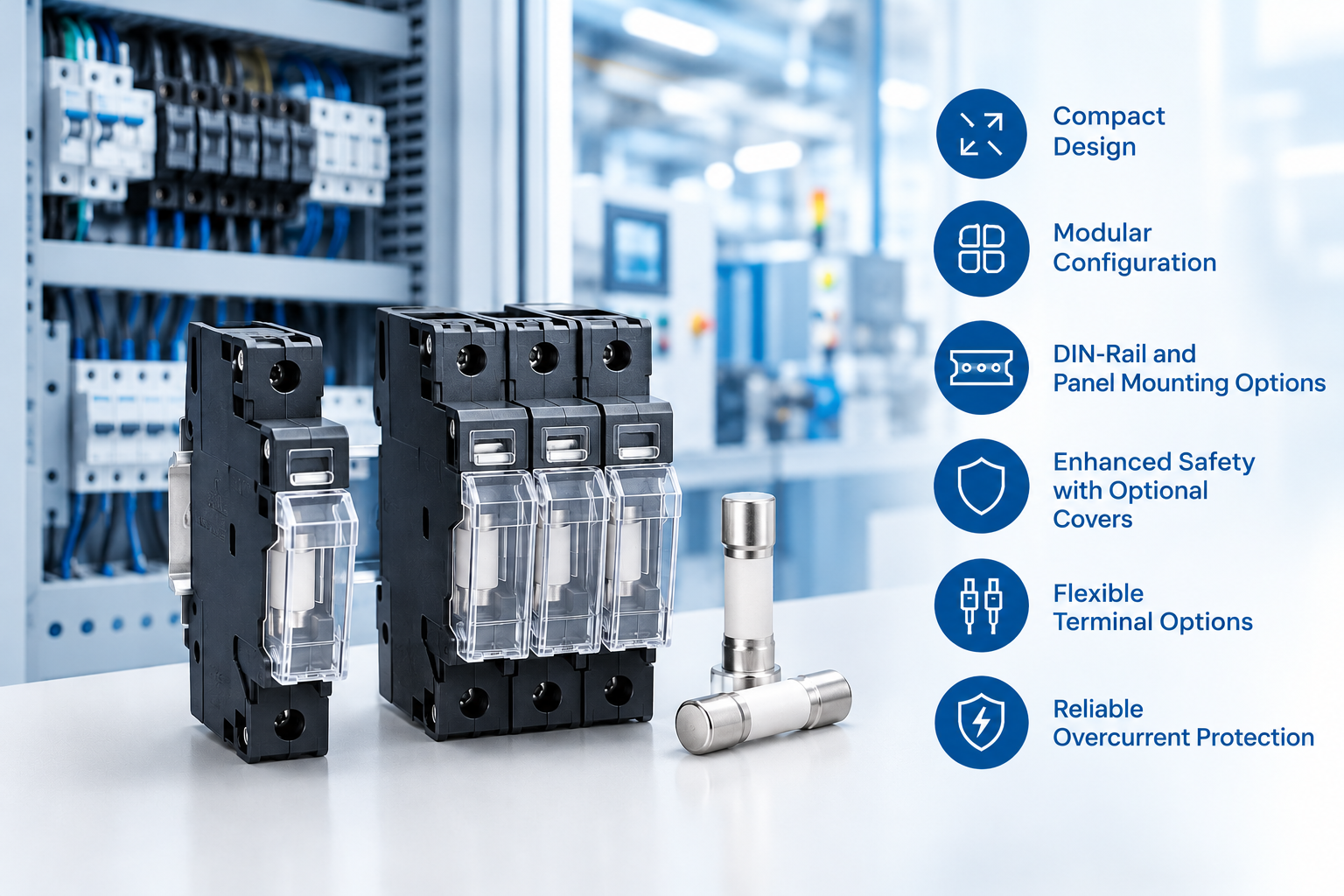
1. Compact Design for Space-Saving Electrical Panels
Space is often limited in industrial control cabinets and electrical distribution panels. A compact fuse holder helps engineers make efficient use of the available installation area without compromising the overall organisation of the panel.
Eaton Bussmann Series Class CC fuse blocks feature a compact footprint, making them suitable for applications where efficient panel layout is a priority.
This can be particularly beneficial for machine builders, OEMs and control panel manufacturers working with increasingly dense electrical assemblies.
2. Modular Design for Flexible Configurations
The Bussmann Series Class CC fuse blocks feature a modular design, with compatible blocks that can be snapped together to create multi-pole assemblies.
Available configurations include one-, two- and three-pole arrangements, helping simplify the selection and assembly process for different circuit layouts.
The modular approach can also help reduce inventory requirements, as suitable single-pole blocks can be combined at the point of use rather than requiring every possible multi-pole configuration to be stocked separately.
3. DIN-Rail and Panel Mounting Options
Different electrical installations require different mounting arrangements. Eaton's Class CC fuse blocks offer DIN-rail and panel-mount versatility, supporting integration into a variety of control panel designs.
This flexibility can simplify equipment design and help standardise components across different projects, provided the selected model meets the application's electrical and mechanical requirements.
4. Optional Finger-Safe Covers
Electrical safety is a key consideration during equipment installation and maintenance. Selected Class CC fuse block configurations offer optional transparent covers with IP20 finger-safe protection.
Depending on the model, cover features can include provisions for lockout/tagout and visual indication of an open circuit.
Transparent covers can also make it easier to inspect the fuse area without removing the cover during routine visual checks. The exact protection and indication features depend on the selected product configuration.
5. Multiple Terminal Options
Efficient wiring and assembly are important in high-volume panel manufacturing. Eaton offers terminal options designed to meet different installation requirements, including 1/4-inch quick-connect terminals on applicable models.
Choosing the appropriate terminal arrangement can help streamline panel assembly and support a more organised wiring layout.
Always check the individual product datasheet to confirm terminal compatibility, conductor requirements and installation specifications.
6. Durable Fuse Clip Construction
Eaton specifies tin-plated bimetallic copper fuse clips for its Class CC fuse blocks. The manufacturer identifies their fatigue resistance as an advantage over conventional spring-brass designs.
Reliable contact performance is important in electrical assemblies, where the fuse holder must maintain an appropriate connection under the specified operating conditions.
Correct installation, suitable conductor selection and compliance with the manufacturer's instructions remain essential for dependable long-term performance.
Benefits of Using Eaton Bussmann Series Class CC Fuse Holders
Selecting the right fuse holder can influence more than circuit protection alone. It can also affect panel assembly, maintenance and component standardisation.
Key benefits include:
-
Efficient use of panel space: Compact dimensions help support space-conscious control panel designs.
-
Flexible assembly: Modular blocks make it easier to configure compatible one-, two- and three-pole arrangements.
-
Simplified mounting: DIN-rail and panel-mount options provide flexibility for different electrical enclosures.
-
Improved circuit identification: Available marker labels help technicians identify circuits more easily.
-
Additional safety features: Selected covers provide IP20 finger-safe protection and may support lockout/tagout procedures.
-
Streamlined assembly: Available terminal options can help meet different wiring and production requirements.
-
Potential inventory savings: Modular construction can reduce the need to stock multiple preassembled pole configurations.
For manufacturers building electrical panels at scale, these features can help simplify component selection and standardise designs across product families.
Typical Applications of Class CC Fuse Holders
Eaton Bussmann Series Class CC fuse holders are intended for use with compatible Class CC fuses in suitable electrical installations. Common application areas include the following.
Industrial Control Panels
Control panels contain a range of electrical components that require appropriate overcurrent protection. Class CC fuse holders provide a practical mounting solution for compatible fuses used in control and branch circuit applications.
Control Transformers and Relay Circuits
Control transformers and relay circuits may experience temporary current surges during normal operation. Where the application requires it, an appropriately selected time-delay Class CC fuse can help accommodate these conditions while providing overcurrent protection.
The fuse holder must be compatible with the chosen fuse and the circuit's electrical requirements.
Machinery and Automation Systems
Automated production equipment relies on properly coordinated electrical protection for its control circuits and associated components. Compact fuse holders can help panel builders integrate circuit protection into machinery control cabinets.
Lighting Circuits
Some lighting applications use fast-acting Class CC fuses. The appropriate fuse characteristic depends on the load, inrush current, circuit design and applicable electrical requirements.
OEM Equipment and Electrical Assemblies
Original equipment manufacturers can benefit from modular fuse blocks when designing multiple machine or equipment variants. Standardised mounting arrangements and pole configurations can simplify panel layouts, subject to the requirements of each specific design.
How to Choose the Right Eaton Bussmann Series Class CC Fuse Holder
Selecting a fuse holder requires more than matching its physical dimensions to a fuse. The holder, fuse and electrical installation must be suitable for the intended application.
Consider the following factors before choosing a product.
1. Fuse compatibility
Confirm that the holder is designed for the specific Class CC fuse you intend to use. Do not assume that a fuse holder for another fuse class is interchangeable.
2. Electrical ratings
Check the holder's voltage and current ratings, as well as the fuse's ratings and interrupting capacity. The complete assembly must be suitable for the system's operating conditions and available fault current.
3. Number of poles
Determine whether the application requires a single-pole, two-pole or three-pole configuration. Check the circuit diagram and applicable design requirements before selecting the assembly.
4. Mounting arrangement
Choose between DIN-rail and panel mounting according to the enclosure design, available space and installation requirements.
5. Cover and safety requirements
Assess whether a transparent cover, finger-safe protection, circuit indication or lockout/tagout provisions are required. Verify the features and limitations of the exact model.
6. Terminal and wiring requirements
Check the terminal type, permitted conductor sizes, connection method and installation torque specified by the manufacturer.
7. Applicable standards
Confirm that the fuse holder and fuse meet the standards and approvals required for the intended market and application. UL Class CC products should not automatically be assumed to satisfy every IEC, CE or local installation requirement.
Review the manufacturer's current technical documentation before finalising your selection.
Class CC Fuse Holders vs. Class CC Fuses: What's the Difference?
Although the terms are sometimes used together, fuse holders and fuse links perform different functions.
A Class CC fuse is the protective device that interrupts the circuit when specified overcurrent conditions cause it to operate. Its characteristics determine how it responds to overloads and short circuits.
A Class CC fuse holder provides the mounting and electrical contact arrangement for the compatible fuse. It helps integrate the fuse into the electrical assembly but does not replace the fuse's protective function.
Both components must be selected correctly. A suitable fuse installed in an incompatible holder is not an acceptable substitute for a properly specified assembly.
Why Choose Eaton Bussmann Series?
Eaton's Bussmann Series portfolio includes circuit protection products for a variety of industrial and commercial applications. Its Class CC fuse blocks and holders combine modular construction, compact dimensions and a choice of mounting and connection options.
For panel builders and electrical engineers, the range offers practical features for designing organised control panels and integrating compatible Class CC fuses.
The most appropriate product depends on the specific electrical ratings, mounting requirements, safety provisions and fuse characteristics needed for the application. Consulting Eaton's official product documentation is therefore an important part of the selection process.
Frequently Asked Questions About Eaton Bussmann Series Class CC Fuse Holders
What is a Class CC fuse holder used for?
A Class CC fuse holder provides a mounting and electrical connection for a compatible Class CC fuse. It is commonly incorporated into suitable industrial control panels, branch circuits and equipment protection arrangements.
Are Eaton Bussmann Class CC fuse holders available for DIN-rail mounting?
Yes. Eaton lists DIN-rail and panel-mount options for its Class CC fuse blocks. Confirm the mounting method of the specific model before ordering.
Are Eaton Bussmann Class CC fuse blocks available in different pole configurations?
Yes. The product range includes one-, two- and three-pole configurations. Modular designs allow compatible blocks to be combined where appropriate.
Do Eaton Bussmann Class CC fuse holders have finger-safe covers?
Selected configurations offer optional transparent covers with IP20 finger-safe protection. Additional features may include lockout/tagout provisions and open-circuit indication, depending on the model.
How do I select a compatible Class CC fuse?
Check the fuse holder's specifications, the fuse manufacturer's documentation and the electrical requirements of the application. Confirm voltage, current, interrupting capacity, fuse characteristics and applicable approvals before installation.
Where can I find Eaton Bussmann Series Class CC fuse holder specifications?
The Casadaa product page for Eaton provides access to product information and available resources. Consult the relevant model documentation for detailed dimensions, ratings, connection requirements and installation instructions.
Conclusion: A Flexible Solution for Industrial Circuit Protection
Eaton Bussmann Series Class CC fuse holders provide a compact, modular option for integrating compatible Class CC fuses into industrial control panels and electrical equipment. With multiple pole configurations, DIN-rail and panel mounting options, optional protective covers and different terminal arrangements, the range supports a variety of panel design requirements.
For electrical engineers, OEMs and panel builders, the key is to select a holder that matches the fuse, circuit ratings, mounting arrangement and applicable safety standards.
Explore the Eaton Bussmann Series Class CC fuse blocks and holders range to review available configurations and identify a suitable solution for your application.



