
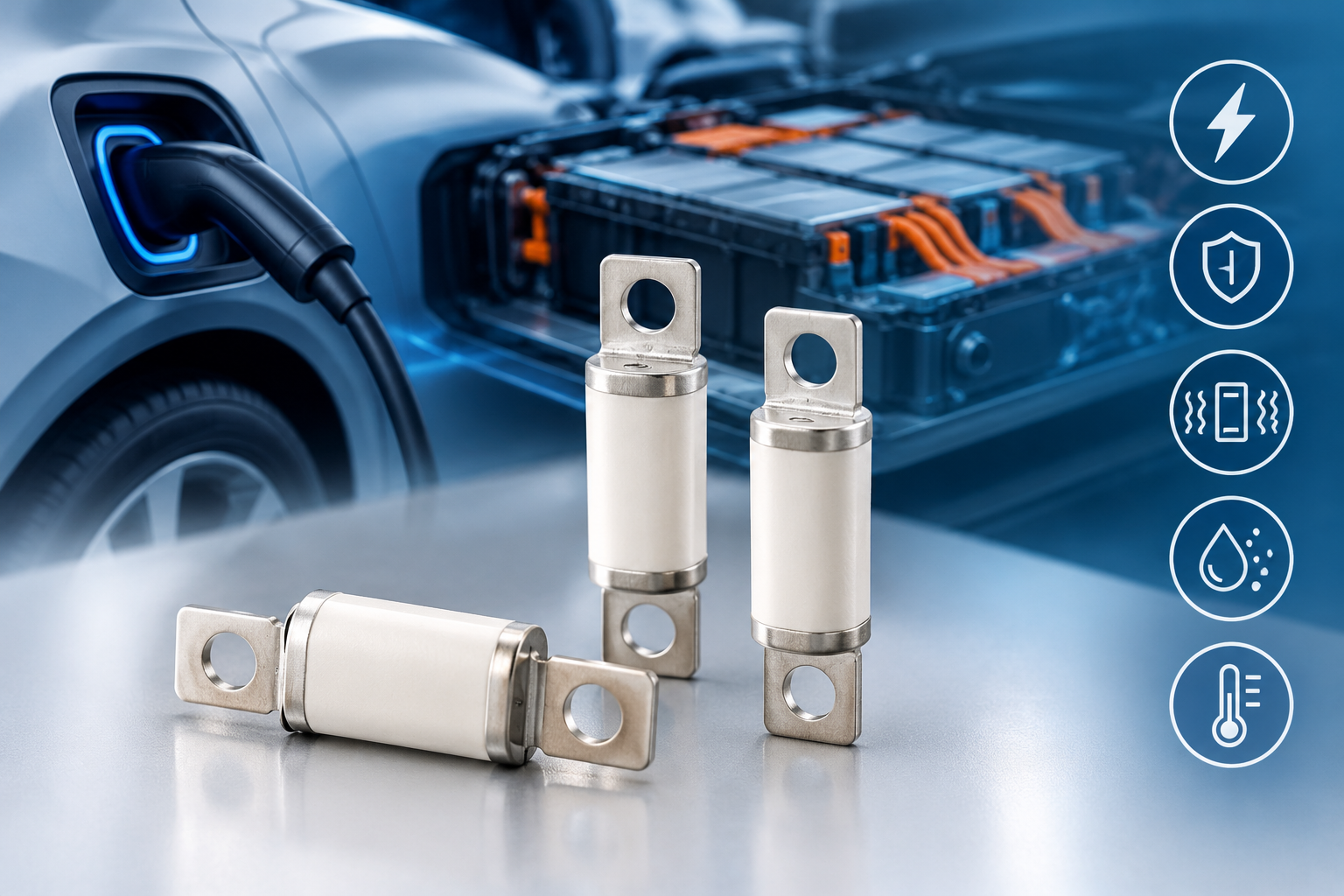
 eaton-ev-fuse-catalogue-emob0062-en-us.pdf  | [Eaton Bussmann EV Fuses] | 0 kB |
Eaton Bussmann EVR 60 mm Fuses: High-Current Protection for Electric Vehicles
As electric vehicle (EV) technology continues to evolve, reliable electrical protection is essential for maintaining system safety, efficiency and performance. High-voltage battery packs require robust fuse solutions capable of handling substantial current loads while interrupting dangerous fault currents when necessary. The Eaton Bussmann EVR 60 mm fuses are designed to meet these demanding requirements, offering high-current protection for electric vehicle applications and other high-power battery systems.
With a rated voltage of 500 V DC, current ratings ranging from 700 A to 1000 A, and a maximum breaking capacity of 50 kA, the EVR 60 mm fuse range supports the protection requirements of modern high-capacity battery packs.
In this guide, we explore the technical specifications, key features, available models, compliance information and important selection considerations for Eaton Bussmann EVR 60 mm fuses.
What Are Eaton Bussmann EVR 60 mm Fuses?
The Eaton Bussmann EVR 60 mm series is a range of high-current DC fuses developed for demanding electrical protection applications, particularly those associated with electric vehicle battery systems.
As EV manufacturers adopt higher-voltage battery architectures and increasingly powerful electrical systems, protective components must be capable of handling high operating currents and interrupting substantial fault currents. The EVR 60 mm range addresses these requirements through its 500 V DC voltage rating, current ratings up to 1000 A and maximum breaking capacity of 50 kA.
The series includes four current ratings:
-
EVR60-700: 700 A
-
EVR60-800: 800 A
-
EVR60-900: 900 A
-
EVR60-1000: 1000 A
These options allow engineers to select a fuse rating suited to their system's electrical requirements, subject to the appropriate circuit protection and coordination assessment.
Eaton Bussmann EVR 60 mm Fuse Technical Specifications
Understanding the technical specifications is essential when selecting a fuse for a high-voltage DC application.
| Technical parameter | Specification |
|---|---|
| Product series | Eaton Bussmann EVR 60 mm |
| Rated voltage | 500 V DC |
| Rated current | 700 A–1000 A |
| Maximum breaking capacity | 50 kA |
| Minimum breaking capacity | 200% of rated current |
| Time constant | 1–3 ms |
| Screw type | M10 |
| Weight | 0.85 kg per fuse |
| Packaging quantity | 14 units per box |
| Storage temperature | −40°C to +85°C |
| Torque limit | 20 Nm, +10%/−0% |
| Environmental compliance | RoHS, ELV and REACH compliant |
Note: Confirm the applicable manufacturer's datasheet and installation instructions for the exact product revision, test conditions and application requirements before specifying or installing a fuse.
Key Features and Benefits of EVR 60 mm Fuses
1. 500 V DC Rated Voltage for Higher-Voltage Battery Systems
The Eaton Bussmann EVR 60 mm fuse range has a rated voltage of 500 V DC, making it relevant to battery systems designed around higher-voltage electrical architectures.
Higher system voltages can help reduce current for a given power demand. This can allow the use of smaller, more economical conductors when the complete system is appropriately engineered.
For EV manufacturers, this can support improvements in electrical system efficiency, conductor sizing and overall design optimisation. Actual benefits depend on the system architecture, operating conditions and applicable design requirements.
2. High Current Ratings from 700 A to 1000 A
High-power battery systems can require substantial current to support acceleration, power delivery and other demanding operating conditions.
The EVR 60 mm series offers four rated current options, from 700 A to 1000 A, providing flexibility for different electrical designs.
Choosing the correct rating involves more than matching the fuse to the nominal operating current. Engineers must also consider continuous loading, transient currents, ambient temperature, thermal conditions, cable protection and coordination with other protective devices.
3. Maximum Breaking Capacity of 50 kA
Fault currents in high-capacity battery systems can reach dangerous levels. A fuse must therefore be capable of safely interrupting the prospective fault current under its specified operating conditions.
The EVR 60 mm series has a maximum breaking capacity of 50 kA, providing a key specification for evaluating its suitability in high-energy DC applications.
The maximum breaking capacity should be assessed against the prospective short-circuit current of the application. The system voltage, circuit characteristics and manufacturer's test conditions must also be considered when verifying suitability.
4. Minimum Breaking Capacity of 200% of Rated Current
The specified minimum breaking capacity is 200% of the fuse's rated current.
This parameter is important when evaluating the fuse's interruption characteristics and determining whether the device is suitable for the expected fault-current range.
Designers should review the manufacturer's time-current characteristics and relevant application guidance to confirm that the fuse can operate correctly under the anticipated fault conditions.
5. Time Constant of 1–3 ms
The EVR 60 mm series specifies a time constant of 1–3 milliseconds.
In DC circuits, the time constant is an important parameter in short-circuit interruption because DC fault currents do not benefit from the natural current zero crossings found in AC systems.
The specified time constant helps engineers assess the fuse's suitability for the electrical characteristics of the intended application. It should be considered alongside the prospective fault current, circuit inductance and manufacturer's interruption data.
6. Robust M10 Screw Connection
The EVR 60 mm fuses use an M10 screw connection and have a specified torque limit of 20 Nm, with a +10%/−0% tolerance.
Correct installation is essential for maintaining a reliable electrical connection and controlling contact resistance and heat generation.
Installers should follow the manufacturer's mounting instructions and use the specified hardware and tightening procedure. Incorrect tightening can compromise the connection and affect long-term performance.
7. RoHS, ELV and REACH Compliance
The EVR 60 mm series is listed as compliant with RoHS, ELV and REACH requirements.
These environmental and chemical compliance frameworks are relevant to manufacturers and suppliers operating in the automotive and electrical industries.
For projects with specific documentation requirements, buyers should obtain the relevant declarations and confirm that the documentation covers the exact part number and product revision being purchased.
Eaton Bussmann EVR 60 mm Fuse Models and Part Numbers
The EVR 60 mm range comprises four models, differentiated by their rated current.
| Part number | Rated current | Packaging quantity | Screw type | Weight |
|---|---|---|---|---|
| EVR60-700 | 700 A | 14 per box | M10 | 0.85 kg |
| EVR60-800 | 800 A | 14 per box | M10 | 0.85 kg |
| EVR60-900 | 900 A | 14 per box | M10 | 0.85 kg |
| EVR60-1000 | 1000 A | 14 per box | M10 | 0.85 kg |
All four models share the stated 500 V DC rated voltage, 50 kA maximum breaking capacity, 1–3 ms time constant and −40°C to +85°C storage temperature range.
The specified torque limit is 20 Nm, +10%/−0%, across the range.
EVR60-700: 700 A Fuse
The EVR60-700 is the 700 A option in the series. It may be considered for systems whose calculated protection requirements are compatible with this rating.
Engineers should verify continuous current demand, overload characteristics, thermal conditions and short-circuit protection requirements before selecting this model.
EVR60-800: 800 A Fuse
The EVR60-800 provides an 800 A rated-current option for applications requiring a higher nominal current rating than the EVR60-700.
Its suitability should be established through a complete electrical protection assessment rather than rated current alone.
EVR60-900: 900 A Fuse
The EVR60-900 is designed for applications requiring a 900 A fuse rating within the EVR 60 mm range.
It shares the series' specified voltage rating, maximum breaking capacity and mounting characteristics, simplifying comparison between the available current ratings.
EVR60-1000: 1000 A Fuse
The EVR60-1000 is the highest-current model in the range, with a rated current of 1000 A.
It can be considered for appropriately designed high-current DC systems where the required fuse rating, fault interruption capability and installation conditions align with the manufacturer's specifications.
Applications of Eaton Bussmann EVR 60 mm Fuses
The EVR 60 mm series is intended for consideration in high-current DC protection applications, particularly those associated with electric vehicle power systems.
Potential application areas include:
-
Electric vehicle battery systems: Protection of high-capacity battery circuits where the voltage, current and fault characteristics are compatible with the fuse specifications.
-
High-power battery packs: Applications requiring high-current circuit protection and verified short-circuit interruption capability.
-
EV power distribution: Protection within suitably engineered DC distribution architectures.
-
Electrified commercial vehicles: Potential use in high-current electrical systems, subject to the vehicle manufacturer's design requirements.
-
Battery-powered industrial equipment: Applications where the electrical ratings, environmental conditions and relevant approvals are suitable.
The exact permitted applications should be confirmed with Eaton's product documentation. A 500 V DC rating does not automatically establish suitability for every EV battery architecture or every location within a vehicle's electrical system.
Standards and Agency Information
The Eaton Bussmann EVR 60 mm fuse range references the following standards:
-
ISO 8820-8:2012
-
GB/T 31465.1-2015
-
GB/T 31465.6-2017
-
GB/T 13539.1-2015
-
GB/T 13539.4-2016
These standards are relevant to automotive fuse requirements and low-voltage fuse systems, depending on the specific document and its scope.
The series is also listed as RoHS, ELV and REACH compliant.
Important: The listed standards should be treated as design references unless the manufacturer explicitly confirms the applicable conformity or certification status for the specific product. Check the current datasheet and relevant declarations before relying on a particular standard for regulatory approval or vehicle qualification.
How to Select the Right EVR 60 mm Fuse
Selecting the correct Eaton Bussmann EVR 60 mm fuse requires a systematic review of the application's electrical and mechanical requirements.
Step 1: Establish the System Voltage
Confirm that the maximum operating voltage and circuit conditions are compatible with the fuse's 500 V DC rating.
The maximum voltage that can occur in the actual battery system must be considered, not just its nominal voltage.
Step 2: Calculate the Required Current Rating
Determine the expected continuous operating current and any relevant transient loads.
Compare the resulting protection requirements with the available 700 A, 800 A, 900 A and 1000 A models. The fuse should be selected in accordance with the manufacturer's application guidance and the required protection of the associated conductors and equipment.
Step 3: Verify Prospective Short-Circuit Current
Calculate or determine the prospective fault current at the installation point.
The fuse's 50 kA maximum breaking capacity must be sufficient for the relevant system conditions. Also verify the applicable minimum breaking characteristics and interruption performance.
Step 4: Check Thermal and Environmental Conditions
Review ambient temperature, enclosure design, cooling, conductor sizing and connection resistance.
The specified storage temperature of −40°C to +85°C describes storage conditions; it should not automatically be interpreted as the permitted operating-temperature range.
Step 5: Confirm Mechanical Compatibility
Verify that the M10 screw connection, available mounting space, clearances and required torque are compatible with the installation.
Use the manufacturer's specified tightening procedure and suitable connection hardware.
Step 6: Review Standards and Documentation
Check the current product datasheet, time-current curves, interruption data and applicable compliance documentation.
For automotive applications, coordinate the fuse selection with the battery protection strategy, contactors and other relevant system components.
Frequently Asked Questions About Eaton Bussmann EVR 60 mm Fuses
What is the rated voltage of Eaton Bussmann EVR 60 mm fuses?
The EVR 60 mm series has a rated voltage of 500 V DC.
What current ratings are available?
The range includes four models: EVR60-700 (700 A), EVR60-800 (800 A), EVR60-900 (900 A) and EVR60-1000 (1000 A).
What is the maximum breaking capacity?
The specified maximum breaking capacity is 50 kA. Suitability must be verified against the prospective fault current and applicable circuit conditions.
What is the minimum breaking capacity?
The specified minimum breaking capacity is 200% of rated current. Consult the manufacturer's documentation for the precise interpretation and test conditions.
What is the time constant?
The specified time constant is 1–3 ms, an important consideration when evaluating fuse interruption performance in DC circuits.
What type of screw connection does the EVR 60 mm series use?
All four listed models use an M10 screw connection.
What is the recommended tightening torque?
The listed torque limit is 20 Nm, with a +10%/−0% tolerance. Always confirm the manufacturer's installation instructions for the exact product revision.
Are Eaton Bussmann EVR 60 mm fuses RoHS, ELV and REACH compliant?
The series is listed as compliant with RoHS, ELV and REACH requirements. Obtain the appropriate manufacturer documentation when formal verification is required.
Conclusion: High-Current DC Protection for Demanding EV Applications
The Eaton Bussmann EVR 60 mm fuse series provides four high-current options for applications requiring a 500 V DC rated voltage and rated currents from 700 A to 1000 A. With a specified maximum breaking capacity of 50 kA, a 1–3 ms time constant and M10 screw connections, the range offers important technical characteristics for engineers evaluating protection solutions for high-capacity battery systems.
Whether you are comparing the EVR60-700, EVR60-800, EVR60-900 or EVR60-1000, the final selection should be based on the system voltage, continuous current demand, prospective fault current, thermal conditions, mechanical compatibility and applicable standards.
Review the manufacturer's latest technical documentation to confirm product suitability and ensure the selected fuse meets the specific requirements of your application.
Looking for Eaton Bussmann EVR 60 mm fuses? Compare the four available current ratings and consult the relevant technical documentation to identify the appropriate model for your electrical protection requirements.



