
 eaton-ev-fuse-catalogue-emob0062-en-us.pdf  | [Eaton Bussmann EV Fuses] | 0 kB |
Where Are Fuses Used in Electric Vehicles? A Complete Guide to EV Fuse Applications
Introduction
Electric vehicles (EVs) rely on sophisticated electrical systems to deliver reliable performance, efficient power conversion, and safe operation. Unlike conventional vehicles, which primarily use low-voltage electrical systems, electric vehicles incorporate high-voltage battery packs and multiple power electronic components that require specialised electrical protection.
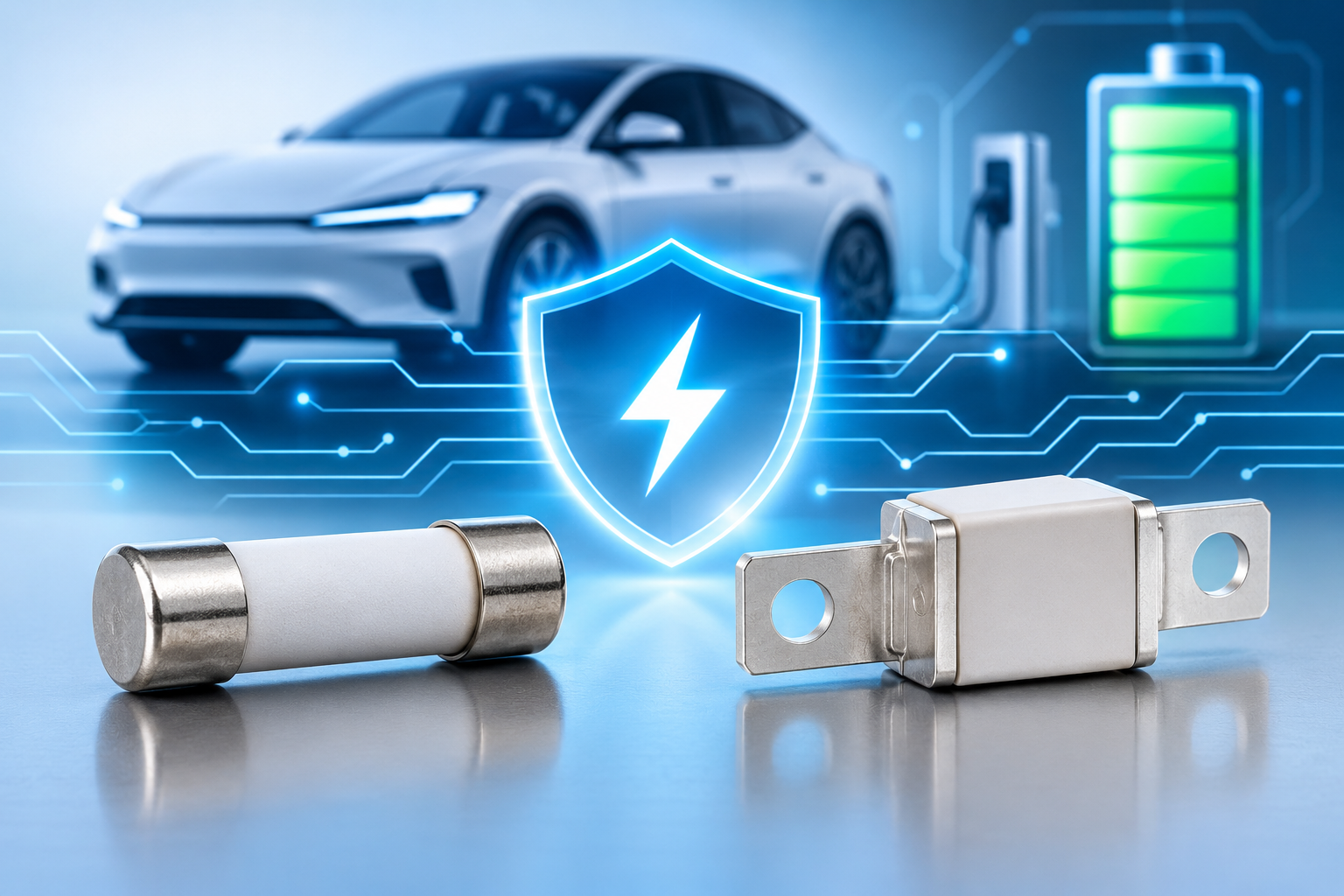
One of the most important components in EV electrical safety is the fuse. Fuses protect electrical circuits against overcurrent conditions and short circuits by interrupting the flow of electricity when the current exceeds a predetermined limit.
But where exactly are fuses used in electric vehicles?
Depending on the vehicle's electrical architecture, fuses can be installed in several critical locations, including the battery pack, traction inverter, onboard charger, DC/DC converter, and auxiliary electrical circuits.
Understanding these applications is essential for engineers, manufacturers, and anyone involved in electric vehicle electrical system design.
In this guide, we explore the main applications of fuses in electric vehicles, their functions, and the important factors to consider when selecting the right fuse for an EV system.
1. Battery Pack and Main Battery Circuit
The battery pack is the primary energy source of an electric vehicle. It stores electrical energy and supplies power to the vehicle's propulsion system and other electrical components.
Because EV battery packs operate at high DC voltages and can deliver extremely high fault currents, reliable overcurrent protection is essential.
Where are fuses installed?
The main battery fuse is generally installed inside or near the battery junction box. It protects the primary electrical connection between the traction battery and the vehicle's high-voltage electrical system.
Why is fuse protection important?
A battery fuse helps protect against:
-
Short circuits in the high-voltage circuit.
-
Excessive current caused by electrical faults.
-
Potential damage to cables and connected components.
-
Electrical hazards associated with uncontrolled fault currents.
The main battery fuse must be coordinated with battery contactors, electrical conductors, and other protective devices to ensure effective system protection.
2. Traction Inverter
The traction inverter is a critical component of an electric vehicle's powertrain. It converts DC electricity from the battery into the electrical power required by the electric motor.
It also plays an important role during regenerative braking, when energy generated by the motor is converted back into electrical energy and returned to the battery.
Where are fuses installed?
Depending on the vehicle's electrical architecture, dedicated fuse protection may be installed in the inverter's power supply branch. In other designs, the main battery protection arrangement may provide protection for this circuit.
Why is fuse protection important?
The traction inverter experiences different operating conditions, including:
-
High current during vehicle acceleration.
-
Temporary current peaks during motor operation.
-
Changing electrical loads during regenerative braking.
-
Potential short circuits and internal electrical faults.
Selecting a suitable fuse requires considering both normal operating current and temporary current peaks. The fuse must provide effective fault protection without interrupting normal vehicle operation unnecessarily.
3. Onboard Charger (OBC)
The onboard charger, commonly known as the OBC, manages the transfer of electrical energy from an external AC power supply to the vehicle's battery.
It converts incoming AC electricity into DC electricity suitable for charging the high-voltage battery.
Where are fuses installed?
Fuse protection may be installed in different sections of the onboard charging circuit, including the DC side, depending on the electrical architecture and protection strategy.
Why is fuse protection important?
The onboard charger contains power electronic components that must be protected against abnormal current conditions.
Appropriate fuse protection helps:
-
Protect charging circuit components.
-
Limit damage caused by short circuits.
-
Improve electrical system reliability.
-
Support safe and reliable battery charging.
It is important to note that the operating conditions of an onboard charger differ from those of a traction inverter. Therefore, fuse selection should be based on the actual electrical characteristics of the charging circuit rather than current rating alone.
4. DC/DC Converter
An electric vehicle uses both high-voltage and low-voltage electrical systems.
The DC/DC converter transfers electrical power from the high-voltage battery system to lower-voltage circuits, commonly supplying the vehicle's 12V or 48V electrical network.
These lower-voltage systems support various vehicle functions, including lighting, control units, electronic systems, and other accessories.
Where are fuses installed?
Depending on the electrical design, fuse protection may be installed on the input side of the DC/DC converter, the output side, or both.
Why is fuse protection important?
The DC/DC converter connects different electrical sections of the vehicle. A fault in one section could potentially affect other connected circuits.
Fuse protection helps:
-
Protect converter components against overcurrent.
-
Limit the impact of electrical faults.
-
Protect connected cables and electrical equipment.
-
Improve the reliability of low-voltage power distribution.
The correct fuse must be selected according to the converter's voltage, current characteristics, and potential fault conditions.
5. Auxiliary DC Electrical Circuits
In addition to the main powertrain and charging systems, electric vehicles contain numerous auxiliary electrical components.
These components consume electrical energy to support vehicle comfort, thermal management, and overall functionality.
Common examples include:
-
Electric air-conditioning compressors.
-
Electric heating systems.
-
Coolant pumps.
-
Battery thermal management systems.
-
Electric power steering systems.
-
Other auxiliary electrical loads.
Where are fuses installed?
Individual auxiliary circuits may have dedicated fuse protection, depending on their power requirements and electrical configuration.
Why is fuse protection important?
Auxiliary systems may operate under different electrical conditions and have different current requirements.
Dedicated protection can help prevent a fault in one auxiliary circuit from damaging its wiring or affecting other parts of the electrical network.
The fuse rating and characteristics should match the specific load and operating conditions of each circuit.
Why Does Fuse Location Matter in Electric Vehicles?
Not all electric vehicle fuses perform the same function. Even when two fuses have identical current ratings, they may not be suitable for the same application.
For example, a battery pack fuse and an onboard charger fuse may carry similar rated currents but experience significantly different electrical conditions.
Several factors must be evaluated before selecting an EV fuse.
1. Rated Voltage
The fuse must have an appropriate DC voltage rating for the electrical circuit it protects.
The rated voltage should be equal to or greater than the maximum operating voltage of the application.
2. Continuous Operating Current
The continuous current rating must be suitable for the normal operating current of the protected circuit.
Engineers should also consider temporary current increases and the expected operating profile.
3. Peak Current and Current Cycles
Electric vehicle electrical systems experience changing loads during acceleration, regenerative braking, charging, and other operating conditions.
The fuse must withstand normal current peaks while still providing reliable protection against actual electrical faults.
4. Breaking Capacity
Breaking capacity refers to the maximum prospective fault current that a fuse can safely interrupt under specified conditions.
This is particularly important in high-voltage battery applications, where available fault currents can be substantial.
5. Operating Temperature
Temperature affects fuse performance and current-carrying capacity.
Engineers should consider ambient temperature, heat generated by nearby components, ventilation, and installation conditions.
6. Installation and Connection Requirements
Physical dimensions, mounting arrangements, terminal connections, and available installation space must also be considered.
The fuse must be electrically suitable and mechanically compatible with the vehicle's electrical system.
7. Coordination with Other Protection Devices
EV fuse protection must work together with contactors, cables, circuit protection devices, and other safety components.
Proper coordination helps ensure that electrical faults are interrupted effectively without unnecessary disruption to other circuits.
Which Standards Apply to Electric Vehicle Fuses?
Standards play an important role in ensuring the safety, performance, and reliability of electrical protection devices used in electric vehicles.
The applicable standard depends on the fuse design, operating voltage, circuit configuration, and intended application.
Two relevant examples include:
IEC 60269-7:2021
This standard covers fuse-links for the protection of batteries and battery systems in circuits with rated voltages up to 1,500V DC.
ISO 8820-8:2019
This standard applies to specific bolt-in fuse-links used in road vehicles, with a rated voltage of 450V DC.
These standards do not apply universally to every EV fuse application. Engineers should always verify the relevant standard, product certification, technical datasheet, and specified operating limits before selecting a fuse.
How to Choose the Right Fuse for an Electric Vehicle
Choosing an appropriate fuse requires more than identifying the required current rating.
The first step is understanding exactly which electrical circuit needs protection.
A practical EV fuse selection process should include the following information:
-
Circuit application: Determine whether the fuse will be installed in the battery pack, traction inverter, onboard charger, DC/DC converter, or auxiliary circuit.
-
System voltage: Confirm the maximum operating voltage of the electrical system.
-
Continuous current: Identify the expected normal operating current.
-
Peak current: Evaluate temporary current peaks and their duration and frequency.
-
Fault current: Determine the maximum prospective short-circuit current.
-
Operating temperature: Consider ambient temperature and installation conditions.
-
Mounting requirements: Confirm the required dimensions, terminal type, and connection method.
-
Protection coordination: Ensure compatibility with contactors, cables, and other protective devices.
For example, specifying a 500A fuse is not enough information to determine whether it is suitable for an electric vehicle.
A 500A fuse intended for a battery circuit may have different requirements from one used in an inverter or power conversion application.
The actual circuit conditions must always guide the selection process.
Frequently Asked Questions (FAQs)
1. Where are fuses commonly used in electric vehicles?
Fuses are commonly used in several EV electrical systems, including:
-
Main battery pack circuits.
-
Traction inverter circuits.
-
Onboard charging systems.
-
DC/DC converters.
-
Auxiliary electrical circuits.
The exact arrangement depends on the vehicle's electrical architecture and protection requirements.
2. Does an electric vehicle need more than one fuse?
Yes, many electric vehicles use multiple fuses to protect different electrical circuits.
A main battery fuse protects the primary battery power path, while additional fuses may be required for charging systems, power converters, and auxiliary electrical loads.
The final protection arrangement depends on the vehicle design.
3. Can the same fuse be used for a battery pack and a traction inverter?
Not necessarily.
Although both applications may require similar current ratings, their operating conditions can differ significantly.
Voltage, current peaks, fault current, breaking capacity, temperature, and installation requirements must all be considered before selecting a fuse.
4. What is the most important specification when selecting an EV fuse?
There is no single specification that determines suitability.
Rated voltage, continuous current, peak current characteristics, breaking capacity, operating temperature, and installation requirements must be evaluated together.
The application and potential fault conditions should determine the final selection.
5. Are EV fuses different from conventional automotive fuses?
Yes. Electric vehicles have high-voltage battery and powertrain circuits that can require specialised fuse designs.
These applications may involve higher DC voltages, substantial fault currents, and demanding electrical operating conditions.
Therefore, conventional low-voltage automotive fuses should not be assumed suitable for high-voltage EV applications.
6. Can a solar photovoltaic fuse be used in an electric vehicle?
A photovoltaic fuse should not automatically be considered suitable for an EV application.
Solar PV and electric vehicle systems can have different current cycles, mechanical conditions, and protection requirements.
Any proposed fuse must be evaluated against the actual electrical and environmental conditions of the EV circuit.
Conclusion
Fuses play an essential role in protecting the electrical systems of modern electric vehicles. From the main battery pack and traction inverter to onboard chargers, DC/DC converters, and auxiliary circuits, fuse protection helps limit the effects of overcurrent conditions and short circuits.
However, each EV application has different electrical characteristics. A fuse suitable for one circuit may not provide the correct protection in another.
For this reason, selecting the right electric vehicle fuse requires a thorough understanding of system voltage, continuous and peak current, prospective fault current, breaking capacity, temperature, and installation requirements.
Ultimately, effective EV electrical protection starts with identifying the circuit, understanding its operating conditions, and selecting a fuse designed to meet its specific requirements.



