
 eaton-bussmann-series-high-speed-fuses-application-guide-br132015en-en-us.pdf  | [Eaton Bussmann Fuses Technical Guide] | 0 kB |
What Is a Time-Delay Fuse and When Is It Needed?
Choosing the right fuse is essential for ensuring the safety and reliability of industrial electrical systems. A time-delay fuse, also known as a slow-blow or time-lag fuse, is a specialised type of fuse designed to withstand short-term overload currents without immediately interrupting the electrical circuit.
In this article, we explain what a time-delay fuse is, how it works and which applications benefit most from its use.
1. What Is a Time-Delay Fuse?
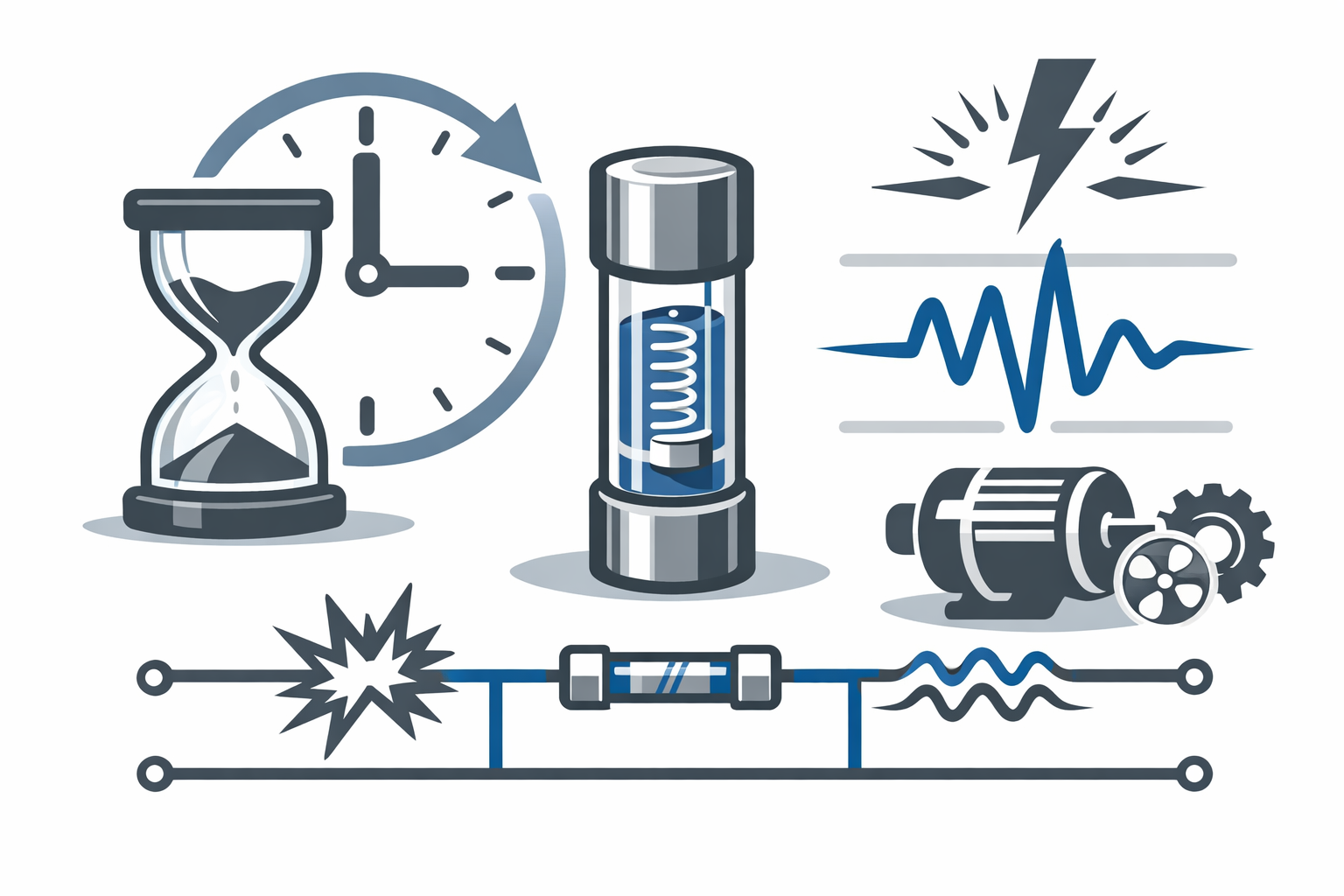
A time-delay fuse is an electrical fuse designed to tolerate temporary overload currents without blowing immediately. Unlike standard fast-acting fuses, which respond quickly to excessive current, a time-delay fuse allows a brief period of overcurrent before disconnecting the electrical circuit.
This is particularly important in applications where temporary current peaks occur during normal operation and should not cause unnecessary fuse failures.
How it works: A time-delay fuse has a specially designed melting characteristic that allows it to withstand short-duration overloads. However, it still interrupts the circuit within its specified operating time when exposed to sustained overloads or short circuits.
Operating characteristics: These fuses are designed to tolerate sudden load increases, which commonly occur when industrial machinery starts up or electric motors are switched on.
2. Why Is a Time-Delay Fuse Necessary?
Many industrial applications and electrical installations experience temporary overloads that do not necessarily represent a safety risk.
For example, electric motors often draw a significantly higher current when starting. Similarly, transformers may require additional current for a short period when energised. These temporary current peaks can cause conventional fuses to blow unnecessarily, interrupting the electrical circuit even though the overload is only temporary.
A time-delay fuse helps prevent this by ensuring that:
-
Short-duration current peaks lasting several seconds can be tolerated without interrupting the power supply.
-
The circuit is disconnected when an overload becomes sustained or reaches dangerous levels.
-
Machinery and equipment that regularly generate high inrush currents remain properly protected.
3. Where Are Time-Delay Fuses Used?
Time-delay fuses are used in various industrial and commercial applications where temporary overload currents may occur during normal operation.
Typical applications include:
Electric Motors
Electric motors generate high starting currents for short periods when switched on. A time-delay fuse protects the motor circuit without unnecessarily interrupting the power supply during the starting process.
Transformers
Transformers can experience temporary inrush currents when energised. A time-delay fuse helps prevent unnecessary interruptions caused by these normal switching currents.
Pumps and Ventilation Systems
Pumps and ventilation equipment can also generate high starting currents. Time-delay fuses help maintain a reliable power supply during these temporary load increases.
Industrial Heating Systems
Industrial heating systems may experience temporary overload conditions that do not represent a genuine fault. A correctly selected time-delay fuse provides reliable electrical protection in these applications.
In all these situations, time-delay fuses help prevent premature circuit interruptions and support the reliable operation of machinery and electrical equipment.
4. Advantages of Time-Delay Fuses
Time-delay fuses offer several advantages over standard fast-acting fuses:
Fewer Unnecessary Shutdowns
By tolerating short-duration overload currents, time-delay fuses prevent unnecessary interruptions and allow machinery to start without repeatedly blowing the fuse.
Longer Equipment Service Life
Equipment that regularly generates high starting currents benefits from appropriately selected time-delay protection, helping to avoid unnecessary interruptions and associated operational problems.
Suitable for Specific Applications
Time-delay fuses can be selected to match the electrical characteristics and operating requirements of individual industrial machines and applications without compromising the required level of protection.
Reduced Operating Costs
By helping to prevent unnecessary production stoppages and repair work, time-delay fuses can contribute to lower operating costs and improved productivity.
5. When Should You Use a Time-Delay Fuse?
A time-delay fuse is particularly beneficial in the following situations:
-
When electric motors or pumps generate high starting currents that last only for a short period.
-
In electrical systems that experience temporary current increases during start-up or load changes.
-
In transformer applications where the initial energisation current is temporarily higher than the normal operating current.
-
In ventilation and heating systems that regularly experience short-duration current peaks.
A time-delay fuse is a suitable choice whenever temporary overload currents are part of normal operation and an immediate interruption of the electrical circuit would be unnecessary.
However, the fuse must always be selected according to the equipment's electrical ratings, the manufacturer's specifications and the applicable protection requirements.
6. Conclusion: The Importance of Time-Delay Fuses in Industrial Applications
Time-delay fuses are an important component of industrial electrical protection. They help protect electrical installations and equipment while accommodating temporary current peaks that occur during normal operation.
They are particularly useful for applications involving electric motors, transformers, pumps and other equipment that generates high inrush currents.
Selecting the correct time-delay fuse helps improve operational reliability, minimise unnecessary downtime and reduce operating costs.
Make sure you choose a fuse that meets the specific requirements of your application to ensure reliable protection and long-term equipment performance.



