
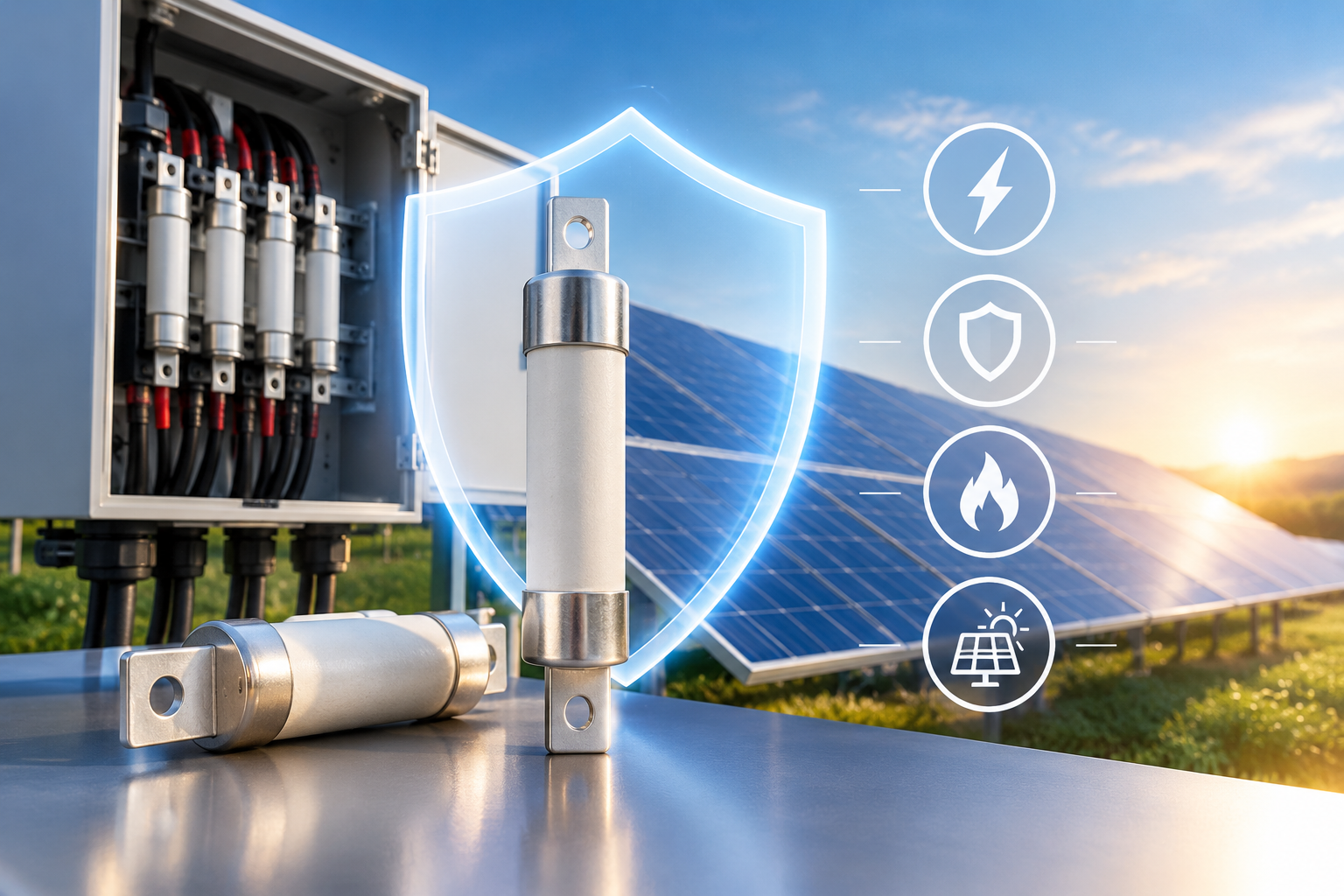
 eaton-bussmann-series-dc-fuses-catalog-ca135009en-us.pdf  | [Eaton Bussmann DC Fuses] | 0 kB |
| eaton-bussmann-series-photovoltaic-fuses-catalogue-ca135004en.pdf | [Eaton Bussmann PV Fuses] | 0 kB |
From Sunlight to Safe Power: How Solar PV Systems Run Smoothly with Eaton Bussmann DC Fuses in Europe
1. Introduction: Turning European Sunlight into Reliable Electricity
Across Europe, solar energy is becoming an increasingly important part of the transition towards cleaner and more sustainable electricity. From residential rooftop installations in Germany and the Netherlands to large-scale solar farms in Spain, Italy and France, photovoltaic (PV) technology is transforming how electricity is generated and consumed.
However, producing electricity from sunlight is only one part of a successful solar installation. Ensuring that electricity flows safely and reliably through the entire system is equally important.
This is where Eaton Bussmann DC fuses play a critical role.
Solar photovoltaic systems operate using direct current (DC), which introduces specific electrical protection requirements. Overcurrent conditions, reverse current and electrical faults can damage solar modules, cables, combiner boxes and inverter components if appropriate protection is not installed.
Eaton Bussmann photovoltaic fuses are specifically designed to address these challenges, helping protect solar PV installations against potentially damaging electrical faults.
From the first rays of morning sunlight to the electricity powering homes, commercial buildings and industrial facilities, reliable DC fuse protection helps keep solar energy systems operating safely and efficiently.
2. How Does a Solar PV System Generate Electricity?
To understand why DC fuses are essential, it is important to understand how a solar photovoltaic system works.
A typical solar PV installation consists of several interconnected components that work together to convert sunlight into usable electricity.
Step 1: Solar Panels Capture Sunlight
Solar panels contain photovoltaic cells that absorb sunlight and convert solar energy into direct current electricity.
Multiple solar panels are connected in series to create a PV string. Several strings may then be connected in parallel to increase the total electricity generated.
Step 2: DC Electricity Travels Through the System
The electricity generated by solar panels flows through DC cables towards the combiner box or inverter.
During this process, the electrical system must be protected against overcurrent conditions and potential faults.
Step 3: DC Fuses Provide Electrical Protection
DC photovoltaic fuses protect individual solar strings and other designated DC circuits.
When an electrical fault creates a current exceeding the fuse's specified operating characteristics, the fuse interrupts the circuit, helping prevent damage to connected equipment.
Step 4: The Inverter Converts DC into AC
Most residential, commercial and industrial electrical installations use alternating current (AC).
The solar inverter converts the DC electricity generated by the panels into AC electricity suitable for local consumption or grid export.
Step 5: Electricity Powers Buildings or Enters the Grid
Once converted, electricity can power household appliances, commercial equipment, industrial machinery or be exported to the electricity grid.
In solar installations equipped with battery storage, additional protection is required for the battery and associated DC connections.
Throughout this process, appropriately selected DC fuses contribute to the safe operation of the entire installation.
3. Why Are DC Fuses Essential for European Solar PV Systems?
Solar installations operate under challenging electrical and environmental conditions.
Unlike conventional AC applications, photovoltaic systems can experience relatively low fault currents while operating at high DC voltages. This makes selecting the correct photovoltaic overcurrent protection particularly important.
Several situations can create electrical risks.
Reverse Current Protection
When multiple PV strings are connected in parallel, a fault in one string can allow current from the healthy strings to flow backwards into the faulty string.
This reverse current can exceed the current-carrying capacity of solar modules and associated conductors.
Appropriately rated gPV fuses help isolate faulty strings and reduce the risk of equipment damage.
Cable and Connector Faults
Damaged insulation, loose connections, deteriorating connectors and incorrect wiring can create abnormal electrical conditions.
DC fuses provide an important layer of protection against overcurrent faults within properly designed circuits.
Equipment Protection
Solar inverters, combiner boxes and other electrical components represent significant investments.
An electrical fault can lead to equipment damage, expensive repairs and unexpected system downtime.
Correctly coordinated DC fuse protection helps reduce these risks.
Fire Risk Reduction
Electrical faults and excessive heating can contribute to fire hazards in photovoltaic installations.
Properly designed and installed overcurrent protection helps reduce these risks by interrupting qualifying fault currents.
For European solar projects, choosing reliable DC photovoltaic fuses is therefore an important part of electrical safety and long-term system performance.
4. How Eaton Bussmann DC Fuses Improve Solar PV System Protection
Eaton Bussmann photovoltaic fuses are developed specifically for the electrical characteristics of solar energy applications.
Unlike conventional fuses designed for general electrical circuits, gPV photovoltaic fuses are engineered to provide protection under the operating conditions commonly found in solar installations.
Here are some of their important characteristics.
Designed for Photovoltaic Applications
Eaton Bussmann gPV fuses are designed for protecting photovoltaic strings, combiner boxes, inverters, recombiner units and battery storage applications.
Their photovoltaic-specific design addresses the challenges associated with high DC voltage and relatively low fault currents.
High DC Voltage Ratings
Modern solar installations increasingly use higher DC system voltages to improve system architecture and reduce certain balance-of-system costs.
Eaton Bussmann offers photovoltaic fuse solutions rated for DC applications up to 1500V, depending on the product series and configuration.
This makes appropriate product selection important for both conventional and utility-scale solar projects.
High Breaking Capacity
A fuse must safely interrupt the prospective fault current available at its installation point.
Certain Eaton Bussmann photovoltaic fuse models offer interrupting ratings of up to 50 kA.
The actual breaking capacity depends on the specific fuse model and its rated operating conditions.
Fast-Acting Overcurrent Protection
PV systems have particular fault-current characteristics.
Eaton Bussmann gPV fuses are designed to respond to overcurrent conditions associated with photovoltaic applications, helping isolate faulty circuits and protect connected equipment.
Compliance with International Standards
Standards compliance is essential when selecting electrical protection equipment for European solar installations.
Eaton Bussmann photovoltaic fuse solutions are designed to meet relevant photovoltaic protection requirements, including IEC 60269-6 for gPV fuse links.
Depending on the product, additional certifications and approvals may include UL and CSA.
These characteristics make Eaton Bussmann DC fuses an important consideration for engineers, installers and system designers looking for photovoltaic circuit protection.
5. Where Are DC Fuses Installed in a Solar PV System?
Understanding the location and function of DC fuses helps engineers design effective photovoltaic protection systems.
Solar String Protection
Individual photovoltaic strings can be protected using appropriately rated gPV fuses.
String protection is particularly important in installations with multiple parallel-connected strings, where reverse current can become a concern.
Combiner Box Protection
A solar combiner box brings together the outputs of multiple PV strings.
Fuses installed within the combiner box help protect individual string circuits and support safer electrical distribution towards the inverter.
Inverter DC Input Protection
The inverter is one of the most important and valuable components in a solar PV installation.
Suitable DC overcurrent protection helps protect designated inverter input circuits against electrical faults.
Fuse selection and placement must follow the inverter manufacturer's requirements and the overall system protection design.
Battery Energy Storage Protection
Many modern European solar installations combine photovoltaic panels with battery energy storage systems.
These systems introduce additional DC protection requirements.
Appropriately selected fuses can help protect battery connections and associated circuits against excessive current.
However, battery protection requires consideration of battery chemistry, available fault current, system voltage and the specific manufacturer's recommendations.
6. Choosing the Right DC Fuse for Solar PV Applications
Selecting a photovoltaic fuse requires more than simply matching the fuse's current rating to the expected operating current.
Several electrical and environmental factors must be considered.
1. DC Voltage Rating
The fuse's rated DC voltage must be equal to or greater than the maximum system voltage under the expected operating conditions.
For European installations, this is particularly important in modern 1000V and 1500V DC solar systems.
2. Current Rating
The fuse current rating must be selected according to the PV module specifications, maximum reverse current, conductor capacity and applicable design requirements.
Incorrect sizing can result in inadequate protection or unnecessary fuse operation.
3. Breaking Capacity
The fuse must have sufficient DC breaking capacity to interrupt the maximum prospective fault current at its installation location.
4. Operating Class
For photovoltaic applications, gPV-class fuses are specifically designed to address the protection requirements of PV circuits.
IEC 60269-6 provides the relevant requirements for these fuse links.
5. Ambient Temperature
Solar installations are frequently exposed to high temperatures, particularly in outdoor combiner boxes and rooftop electrical enclosures.
Temperature-related derating and the manufacturer's operating recommendations must be considered during fuse selection.
6. Fuse Holder Compatibility
The fuse dimensions, mounting arrangement and electrical characteristics must be compatible with the selected fuse holder or fuse base.
7. Standards and Certifications
For European projects, engineers should verify the relevant IEC requirements, product certifications and installation regulations before selecting a fuse.
A correctly selected fuse improves protection coordination and supports long-term photovoltaic system reliability.
7. Why Reliable DC Fuse Protection Matters for Europe's Solar Energy Future
Europe's renewable energy sector continues to expand, creating demand for reliable electrical protection solutions across different photovoltaic applications.
Residential Solar Installations
Homeowners in Germany, Austria, the Netherlands and other European countries are increasingly adopting rooftop solar systems.
Reliable DC fuse protection helps safeguard residential installations and their associated electrical equipment.
Commercial and Industrial Solar Projects
Factories, warehouses, shopping centres and office buildings increasingly use rooftop photovoltaic systems to reduce electricity costs and improve energy independence.
These larger installations often involve multiple PV strings, combiner boxes and high-capacity inverters.
Appropriate DC fuse protection helps reduce the impact of electrical faults and unexpected downtime.
Utility-Scale Solar Farms
Large solar farms require carefully coordinated electrical protection across extensive PV arrays.
With thousands of solar modules operating together, reliable string and array protection becomes especially important.
High-voltage photovoltaic fuse solutions can support the protection requirements of modern solar installations.
Solar Energy Storage Systems
Battery storage is becoming an increasingly important part of Europe's renewable energy infrastructure.
Combining solar generation with energy storage allows electricity to be stored and used when required.
However, battery integration also introduces additional electrical protection considerations, making appropriate DC fuse selection essential.
Across all these applications, dependable photovoltaic protection contributes to safer and more reliable renewable energy infrastructure.
8. The Role of Eaton Bussmann DC Fuses in Improving Long-Term Solar Performance
A solar PV installation is a long-term investment.
Its performance depends not only on the efficiency of the solar modules but also on the reliability of its electrical infrastructure.
An incorrectly selected or poorly coordinated fuse can contribute to unnecessary interruptions, equipment damage and maintenance costs.
By contrast, appropriate Eaton Bussmann photovoltaic fuse solutions can support:
-
Improved electrical safety: Helps protect PV circuits against qualifying overcurrent faults.
-
Equipment protection: Helps reduce the risk of damage to solar modules, conductors and other connected components.
-
System reliability: Supports the isolation of faulty circuits without unnecessarily affecting healthy sections of an installation.
-
Reduced maintenance costs: Helps minimise the consequences of electrical faults and associated downtime.
-
Long-term investment protection: Supports the reliable operation of residential, commercial and utility-scale solar installations.
It is important to remember that DC fuses are one part of a complete electrical protection strategy. Proper system design, installation, inspection and maintenance remain equally important.
9. The Future of Solar PV Protection in Europe
As Europe's solar energy capacity continues to grow, photovoltaic installations are becoming larger, more sophisticated and increasingly integrated with energy storage and smart grid technologies.
Higher-voltage DC architectures, advanced inverter technologies and large-scale battery installations are creating new requirements for electrical protection.
In this evolving environment, photovoltaic-specific DC fuses will remain an essential component of solar system safety.
Eaton Bussmann continues to offer photovoltaic fuse solutions designed for different system configurations and voltage requirements, including applications up to 1500V DC.
For solar installers, EPC contractors, electrical engineers and renewable energy developers, choosing the right protection components is an important step towards building efficient, dependable and future-ready solar infrastructure.
10. Conclusion: Protecting Every Watt from Sunlight to Safe Power
Solar panels may capture the sunlight, and inverters may convert electricity into usable power, but reliable electrical protection is what helps keep the entire system operating safely.
Eaton Bussmann DC photovoltaic fuses provide dedicated overcurrent protection for solar PV applications, helping safeguard strings, combiner boxes, inverters and other critical DC circuits.
From residential rooftops in Germany to commercial solar installations in Spain and utility-scale solar farms across Europe, appropriate DC fuse selection plays an important role in maintaining electrical safety and system reliability.
As the European renewable energy market continues to develop, investing in reliable photovoltaic protection is not simply an engineering consideration. It is an essential part of protecting solar investments and supporting a more sustainable energy future.
From sunlight to safe power, every component matters. And reliable DC fuse protection makes every connection count.



