
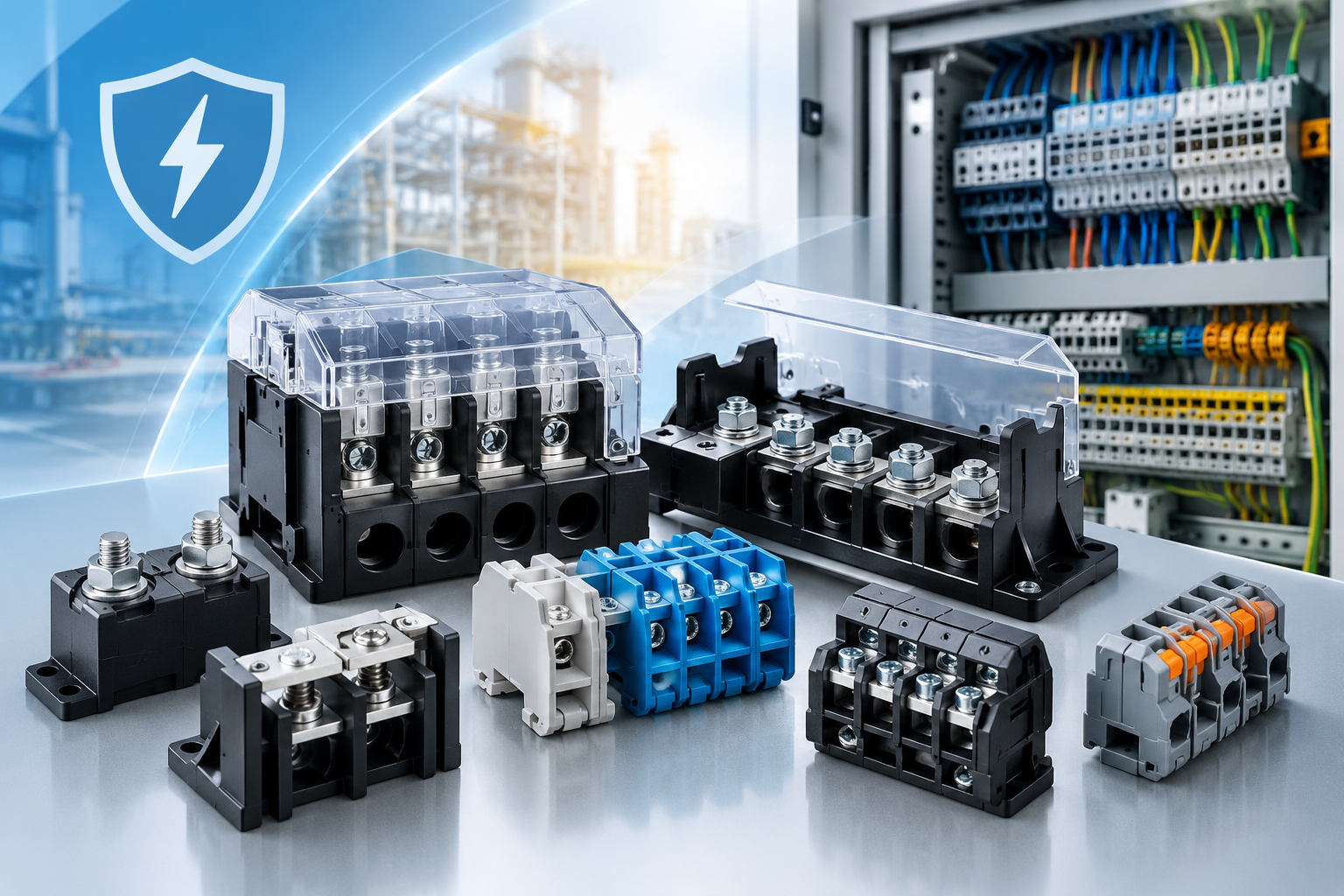
 bus-ele-cat-1007-flc-2018-sec-09-pdbs.pdf bus-ele-cat-1007-flc-2018-sec-09-pdbs.pdf | [Eaton Bussmann series Full line catalog: Power distribution and terminal blocks] | 6399 kB |
Eaton Bussmann Series Power Distribution and Terminal Blocks: A Complete Product Guide
Introduction to Eaton Bussmann Series Power Distribution and Terminal Blocks
Reliable power distribution is essential for industrial control panels, electrical enclosures, machinery, and commercial power systems. Eaton Bussmann series power distribution and terminal blocks help electrical engineers, panel builders, and maintenance professionals distribute electrical power efficiently while supporting safe, organized, and reliable electrical connections.
The Eaton Bussmann Series Full Line Catalog, Section 9, focuses on power distribution and terminal blocks, covering product families designed for different current ratings, installation requirements, conductor configurations, and short-circuit current rating (SCCR) needs.
From finger-safe power distribution blocks to open distribution blocks, power stud terminal blocks, splicer blocks, and traditional terminal blocks, the catalog provides technical information to help users identify suitable components for their applications.
What Are Power Distribution and Terminal Blocks?
Power distribution blocks are electrical components that allow a single incoming power conductor or supply connection to be distributed to multiple outgoing conductors. They simplify wiring layouts and help create organized electrical distribution systems.
Terminal blocks provide secure connection points for electrical conductors, making them useful in control panels, industrial machinery, automation systems, and other electrical installations.
Choosing the correct power distribution block or terminal block can help improve panel organization, simplify installation, and support compliance with applicable electrical standards.
Key Product Categories in the Eaton Bussmann Series Catalog
1. PDBFS Finger-Safe Power Distribution Blocks
The Eaton Bussmann series PDBFS power distribution blocks are designed for applications where compact installation, conductor flexibility, and finger-safe protection are important.
According to the catalog, these blocks offer a modular design that allows individual single-pole units to be combined into multipole configurations. Selected models support DIN-rail or panel mounting, helping engineers adapt their designs to different enclosure layouts.
Key features include:
-
Finger-safe protection under specified installation conditions.
-
High short-circuit current ratings when used with the specified upstream overcurrent protective devices.
-
Support for copper and aluminum conductors, depending on the model.
-
Multiple line-side and load-side conductor configurations.
-
Modular construction for multipole arrangements.
-
Installation flexibility for industrial control panels and wireways.
The catalog lists current ratings from 175 A to 760 A for the PDBFS family and short-circuit current ratings of up to 200 kA under specified conditions.
These power distribution blocks are particularly relevant to industrial applications that require compact power distribution and carefully evaluated electrical protection.
2. PDB Open Power Distribution Blocks
The Bussmann series PDB family consists of UL Listed power distribution blocks designed for applications where an open block configuration is appropriate.
These products provide a practical way to distribute incoming electrical power to multiple outgoing conductors. Depending on the selected model and installation, optional covers may be available to provide an additional level of protection.
When selecting a PDB block, engineers should consider conductor size, current rating, mounting arrangement, available enclosure space, terminal spacing, and the required short-circuit current rating.
The catalog also explains how power distribution block selection relates to electrical panel requirements and applicable installation standards.
3. 160, 162, 163, 164 and 165 Series Open Blocks
The catalog includes several UL Recognized open-block product families, including power distribution, power stud terminal, and power splicer configurations.
These products serve different connection and distribution requirements in electrical equipment.
Power distribution blocks help divide incoming power between multiple outgoing conductors.
Power stud terminal blocks provide stud-based electrical connection points for compatible conductors and installation arrangements.
Power splicer blocks support conductor joining and splicing applications where the selected product's ratings and connection specifications are suitable.
Because these product families have different electrical ratings and intended uses, engineers should consult the relevant catalog tables before choosing a particular catalog number.
4. Power Terminal Blocks
Power terminal blocks provide connection points for electrical conductors in panels, machines, and other electrical equipment.
The Eaton Bussmann series catalog includes UL Recognized terminal block families and provides product information for different connection styles and applications.
When evaluating power terminal blocks, consider:
-
Rated operating voltage and current.
-
Conductor material and wire size.
-
Number of connection points.
-
Mounting requirements.
-
Required electrical clearances and creepage distances.
-
Applicable UL recognition and equipment requirements.
These considerations help ensure that a terminal block is appropriate for the intended electrical installation.
5. Screw and Quick-Connect Terminal Blocks
The catalog also covers the 11675 and 11725 terminal block families, which feature screw and quick-connect termination options.
These products offer connection arrangements for applications requiring the relevant voltage and conductor specifications. The catalog identifies the 11675 family as a 250 V block and the 11725 family as a 600 V block.
Before specifying either product, verify its detailed ratings, conductor compatibility, connection requirements, and suitability for the equipment in which it will be installed.
6. Barrier and Deadfront Terminal Blocks
For applications requiring specific terminal protection and connection arrangements, the catalog includes:
-
14002 barrier terminal block: A 600 V barrier-style terminal block.
-
14004 deadfront terminal block: A 600 V deadfront-style terminal block.
Barrier and deadfront designs can help address terminal accessibility and electrical separation requirements, depending on the product and installation.
The appropriate selection depends on the equipment design, conductor arrangement, operating conditions, and applicable safety requirements.
Understanding Short-Circuit Current Rating (SCCR)
Short-circuit current rating is one of the most important considerations when selecting power distribution blocks for industrial control panels.
SCCR indicates the maximum short-circuit current that equipment or a component is rated to withstand under specified conditions. It must be evaluated alongside the available fault current at the installation point and the ratings of the other equipment components.
The Eaton Bussmann catalog highlights that power distribution and terminal blocks without an appropriately established component SCCR can limit the overall short-circuit current rating of an electrical panel.
The PDBFS and PDB product families are designed to address high-SCCR applications, but their published ratings depend on the specified upstream overcurrent protection and installation conditions.
To select a suitable power distribution block:
-
Determine the available fault current at the installation location.
-
Establish the required SCCR for the complete electrical assembly.
-
Identify the block's tested SCCR under the proposed application conditions.
-
Verify the specified fuse or circuit breaker, including its type and maximum rating.
-
Confirm conductor sizes, terminal requirements, and enclosure dimensions.
-
Verify that the complete installation meets applicable electrical codes and standards.
A component's maximum advertised SCCR should never be assumed to apply to every fuse, circuit breaker, conductor arrangement, or enclosure configuration.
How to Choose the Right Eaton Bussmann Power Distribution Block
Selecting the correct power distribution block requires more than matching the nominal current rating. Engineers should evaluate the complete electrical and mechanical installation.
Current and Voltage Ratings
Choose a product with suitable current and voltage ratings for the intended application. Account for conductor characteristics, operating conditions, and any required derating.
Conductor Compatibility
Check the permitted wire sizes, conductor materials, stranding, number of wires per port, and terminal tightening torque. Copper and aluminum conductors are not interchangeable unless the selected product is specifically rated for the intended conductor type.
Short-Circuit Protection
Verify the product's SCCR under the exact conditions of use. This includes the upstream fuse or circuit breaker, conductor configuration, and other conditions stated in the manufacturer's documentation.
Mounting and Panel Space
Determine whether DIN-rail mounting, panel mounting, or a particular enclosure arrangement is required. Consider the available space, wire routing, access for installation, and maintenance needs.
Finger-Safe Protection
Where protection against accidental contact is a design priority, consider finger-safe products such as the PDBFS series. Confirm the conditions required to achieve the specified protection rating.
Certifications and Standards
Review the product's applicable UL listing or recognition, CSA certification, and other declared approvals. Ensure the selected product is suitable for the relevant equipment category and jurisdiction.
Installation and Maintenance
Review conductor preparation, tightening torque, spacing, enclosure requirements, and installation instructions before assembly. Correct installation is essential to achieving the product's specified performance.
Applications of Power Distribution and Terminal Blocks
Eaton Bussmann series power distribution and terminal blocks can be considered for a variety of electrical applications, provided the selected model meets the required ratings and installation conditions.
Common application areas include:
-
Industrial control panels: Distributing incoming power to multiple circuits and electrical components.
-
Manufacturing equipment: Organizing power connections in machinery and production systems.
-
Electrical enclosures: Creating structured conductor distribution within suitably designed enclosures.
-
Building electrical systems: Supporting power distribution where the selected product is permitted by applicable codes.
-
HVAC equipment: Providing electrical connection and distribution points in compatible equipment designs.
-
Automation systems: Helping organize electrical connections for industrial control and machine automation.
-
Power connection assemblies: Supporting suitable conductor joining, splicing, and stud-based connection requirements.
The correct product depends on the specific application, electrical ratings, protection requirements, and applicable installation standards.
Benefits of Using Eaton Bussmann Series Products
Improved Wiring Organization
Power distribution blocks provide a structured way to distribute electrical power and organize conductors, which can simplify panel layouts and maintenance.
Flexible Installation Options
Selected product families offer DIN-rail mounting, panel mounting, modular configurations, and different line-side and load-side connection arrangements.
Support for High-SCCR Designs
Specified Bussmann series power distribution blocks can achieve high SCCR values when installed with the tested protective devices and under the required conditions.
Multiple Connection Configurations
The catalog includes products designed for different conductor sizes, numbers of connection points, and connection styles, helping engineers match components to their designs.
More Efficient Panel Design
Selecting an appropriately configured distribution block can help reduce wiring complexity and make better use of available enclosure space.
Frequently Asked Questions
What is the Eaton Bussmann Series Full Line Catalog Section 9?
Section 9 of the Eaton Bussmann Series Full Line Catalog 1007 covers power distribution and terminal blocks. It includes product information for finger-safe and open power distribution blocks, power stud terminal blocks, splicer blocks, screw and quick-connect terminal blocks, and barrier and deadfront terminal blocks.
What is the difference between a power distribution block and a terminal block?
A power distribution block is generally used to distribute incoming electrical power to multiple outgoing conductors. A terminal block provides electrical connection points for conductors. The exact functions and permitted applications depend on the specific product's design and ratings.
What does SCCR mean in electrical panel design?
SCCR stands for short-circuit current rating. It is used to evaluate the short-circuit withstand capability of electrical equipment under specified conditions. The available fault current must not exceed the applicable rating of the equipment, and the complete assembly must be evaluated appropriately.
Are Eaton Bussmann PDBFS blocks finger-safe?
The PDBFS family is designed to provide IP20 finger-safe protection under specified conditions. Correct conductor installation, wire preparation, and adherence to the manufacturer's requirements are necessary to achieve the stated protection.
Can Bussmann power distribution blocks accept aluminum conductors?
Certain models are rated for copper and aluminum conductors. Compatibility depends on the particular catalog number, wire size, conductor construction, and terminal specifications. Always verify the manufacturer's product data before installation.
How do I select the correct Bussmann series catalog number?
Identify the required current and voltage ratings, conductor sizes, line-side and load-side connection configurations, mounting method, SCCR, and upstream protective device. Then use the manufacturer's catalog tables to identify a model that meets all applicable requirements.
Why are electrical spacing requirements important?
Electrical spacing requirements help maintain the required separation between energized parts of opposite polarity and between energized parts and grounded components. The required clearances depend on the applicable standard, equipment type, voltage, and installation conditions.
Conclusion
The Eaton Bussmann Series Full Line Catalog for power distribution and terminal blocks provides a useful technical reference for electrical engineers, panel builders, industrial maintenance teams, and equipment designers.
Its product range includes PDBFS finger-safe power distribution blocks, PDB open power distribution blocks, UL Recognized open-block families, power stud terminal blocks, splicer blocks, screw and quick-connect terminal blocks, and barrier and deadfront terminal blocks.
By evaluating current and voltage ratings, conductor compatibility, mounting requirements, SCCR, upstream protection, and applicable standards, professionals can select components that support organized wiring and reliable electrical distribution.
For the best results, always verify the latest manufacturer documentation and product-specific installation requirements before specifying or installing any electrical component.



